How to Reduce Inventory Costs & Unlock Cash with 80/20 Hack

Excess inventory is one of the most expensive mistakes in product businesses — and most owners don’t see the full damage until it’s too late. This guide shows you exactly how to cut inventory costs across the board while freeing up trapped cash in the process.
The true cost of inventory goes far beyond the purchase price
When most business owners think about inventory costs, they think about what they paid the wholesaler. But every unit sitting on your shelf is generating a stack of ongoing costs that silently erode your margins:
- Purchase cost — the wholesale price paid upfront
- Holding costs — rent, insurance & utilities for storage space
- Handling costs — staff hours receiving, counting & managing stock
- Inbound shipping — freight costs from wholesaler to your location
- Write-offs — dead stock that never sells and gets discounted or binned
- Opportunity cost — cash locked in stock that can’t fund growth
These costs compound fast. When your net profit margin is 3–5%, even modest waste across these six categories can wipe out your entire profit — or leave you cash-poor while sales are climbing.
The hidden trap: why excess inventory is a double threat
Excess inventory damages your business in two critical ways at once. It locks up operating cash, creating a painful cycle where higher sales actually leave you with less money in hand. And it leads to write-offs of dead stock, hurting both your bottom line and cash flow simultaneously.
When your profit margin is only 3%, offering a 20–30% discount on slow-moving stock means you lose money on items you’ve already paid for — on top of every holding, handling, and shipping cost already incurred. The attempt to recover costs ends up deepening the loss.
Even if you manage to sell these items above purchase price, you’re still losing money through hidden costs: staff hours spent managing too many SKUs, valuable floor space wasted on items that barely move, warehouse expenses, and the time it takes to train staff across an oversized product range.
The 80/20 magic: fewer products, lower costs, more cash
The solution is to narrow your product line using the 80/20 principle. In most product businesses, 20% of items generate 80% of sales. By cutting the slow movers and focusing on fast-moving products, you reduce inventory costs across every single category simultaneously — and free up the cash that was trapped in underperforming stock.
Here’s a real example with 10 items:
| Item | Avg Monthly Sales | Current Inventory |
|---|---|---|
| Item 1 | 500 | 160 |
| Item 2 | 350 | 120 |
| Item 3 | 40 | 50 |
| Item 4 | 30 | 50 |
| Item 5 | 25 | 50 |
| Item 6 | 20 | 40 |
| Item 7 | 15 | 30 |
| Item 8 | 10 | 20 |
| Item 9 | 5 | 15 |
| Item 10 | 5 | 15 |
Items 1 and 2 — just 20% of the product line — generate 85% of sales. Yet they account for only 280 out of 550 total inventory units. The slow movers (15% of sales) are locking up 50% of your inventory, along with 50% of your associated holding costs, handling time, floor space, and tied-up cash.
Cutting slow movers doesn’t just reduce your stock count — it cuts your storage footprint, your staff workload, your inbound freight volume, and your write-off exposure all at once. The effect on total inventory costs is far larger than the sales reduction.
The minimum order dilemma: why slow movers eat your cash
Look closely at the inventory numbers above. Wholesalers set minimum purchase quantities that force you to buy far more than your monthly sales for slow-moving items. With fast-selling products, you can order weekly and still meet minimums — keeping stock lean and costs low. With slow movers, you’re stuck carrying large orders that sit for months, accumulating holding costs and write-off risk the whole time.
Frequent, smaller orders on fast movers also make it much easier to respond to demand shifts and seasonal changes — further reducing the risk of costly overstock.
Setting inventory levels precisely: the Poisson distribution
For your top sellers, you can also reduce inventory costs by tightening stock levels — without risking lost sales. This is where the Poisson distribution comes in.
The Poisson distribution models random demand with a known average rate, letting you calculate the probability of selling above any given quantity. Take Item 1, with average weekly sales of 125. Why keep 160 in stock? Because the Poisson distribution shows the probability of selling more than 160 units in a week is just 0.1% — a near-zero stockout risk. That buffer protects revenue while staying lean.
Cutting inventory even further is also very safe — the exact amount to cut is ultimately a management judgment.
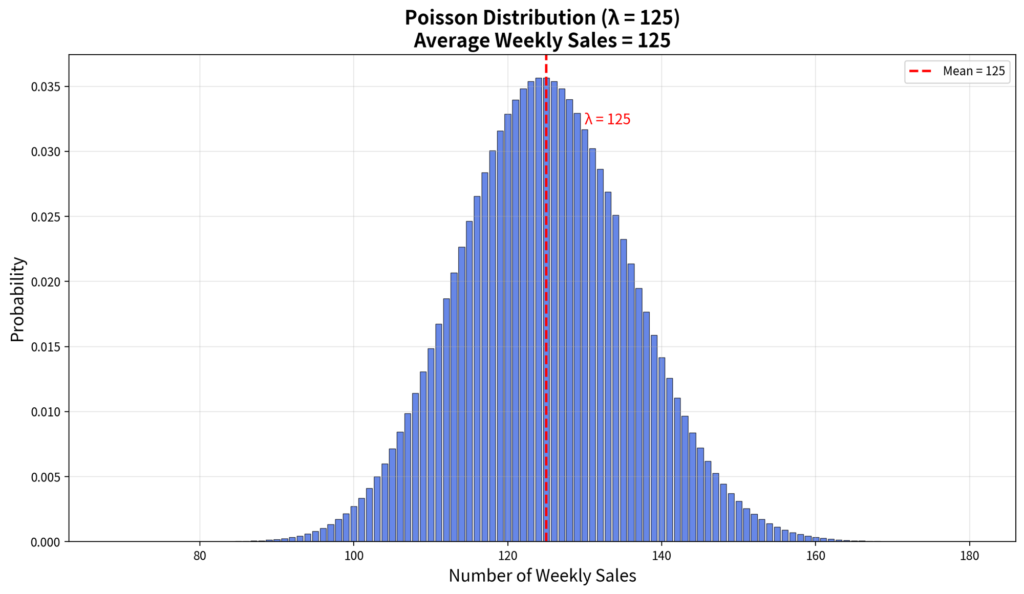
Using Poisson-based stock modelling, you can safely reduce inventory on fast movers below what feels intuitively comfortable — cutting purchase costs, holding costs, and the capital tied up in safety stock, without measurably increasing stockout risk.
Why higher sales don’t guarantee better cash flow
This is the counterintuitive truth at the heart of inventory management: chasing higher sales doesn’t automatically improve your financial position. Often it does the opposite.
Here’s a simple example. With sales of 100 and inventory of 20, you earn a 3% profit of 3. Double your sales by adding stores, and inventory jumps by 20 — requiring immediate cash out. Profit only increases by 3, leaving your net cash flow at −17. Higher sales, less cash.
This is why reducing inventory costs matters even more during growth. As you expand, inventory and all its associated costs scale with you. Excessive cash requirements can completely block growth, even when revenue looks healthy. With leaner inventory, expansion becomes far more manageable.
The result: a lower-cost, higher-cash business
By systematically applying the 80/20 principle to your inventory, you cut costs on every front — purchase quantities, storage, handling, inbound freight, and write-offs — while simultaneously freeing up the cash locked in slow-moving stock. You don’t need to sell more to improve your financial position. Sometimes selling less, but smarter, is the most profitable move you can make.