One Simple Business Hack for Healthy Profit in Expansion 2

Last time we saw that estimating demand cap is crucial for all businesses. This time, we’ll estimate a trickier type of demand.
We’re looking at AirSculpt, a company that specializes in fat removal procedures (also known as liposuction) to reshape the body. In normal liposuction, surgeons have to punch a hole in the patient’s skin to suck out fat. AirSculpt, however, has special technology that allows them to do the procedure with just a small hole. This means patients recover faster, feel less pain, and have smaller surgical scars. But this comes at a price – while normal liposuction costs $6K, AirSculpt costs $12K.
Early Success: Sales Doubling Every Year
The sales of AirSculpt skyrocketed, increasing by more than 100% in 2021. [From 10-K 2021]

The fat removal business in the US seemed very profitable since obesity is such a big social problem. With patients willing to pay $12K per procedure, the business looked like it could become the next Google. But what do you think happened after this? Did sales keep increasing, skyrocketing to the sky and expanding into the universe?
Is This Really the Next Google? Let’s Calculate
Let’s guestimate it! Guestimation means guessing approximate numbers using available information.
The important thing is tracking the customer journey – how patients end up choosing this procedure. Let’s imagine how a patient decides to get liposuction. First, the main target is women aged 40-65 years old. In the US, there are 50 million people in this group.
These potential patients must have above-average weight. Let’s suppose US women’s average weight is 70kg, and the standard deviation is 15kg (this means 68% of women fall between -15kg and 15kg: 55kg and 85kg), and the distribution follows a normal curve (which is common for natural phenomena). This gives us this graph.
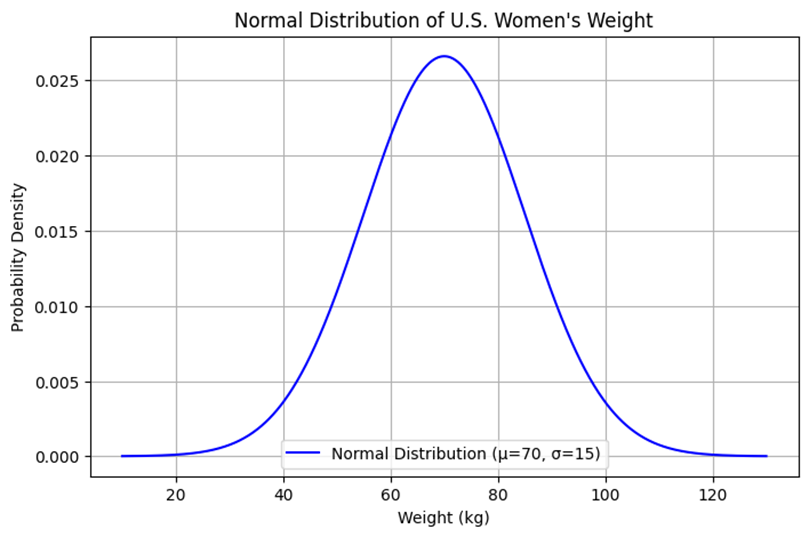
We can assume that people who get liposuction are those who weigh more than 85kg (that’s one standard deviation above average), which is 15.87% of these women.
Then, among these women, one in three will seriously consider dieting each year. Of these motivated people, 70% choose traditional methods like eating less and exercising, while 30% consider plastic surgery. Among the surgery group, there are different options like CoolSculpting or Radiofrequency, but about 40% choose liposuction.
Finding the Total Market Size
So our calculation is: 50M × 15.87% × 1/3 × 30% × 40% = 211,000 potential patients. The actual number of total liposuction operations in the US is 300,000 per year. Our estimate is a bit lower but close enough for guestimation.
Now, using this 300,000 total liposuction number per year, let’s consider AirSculpt’s premium pricing. Since it’s expensive, only people making more than $80K per year (about 25% of the population) can afford it. Among these higher-income patients, maybe 20% would pay double for AirSculpt’s smaller holes. This gives us 5% of the total, or only 15,000 patients per year – our estimated maximum.
AirSculpt’s sales in 2021 were $133M. At $12K per procedure, this means they had about 10,000 patients that year. If they reached our estimated maximum of 15,000 patients per year, their maximum potential sales would be $180M.
What Really Happened: Growth Hits a Wall
So what actually happened to AirSculpt? The sales increased but not like before – no more doubling. In 2023, sales only grew by 16%. [From 10-K 2023]

By 2024, sales growth finally stopped. The first three quarters of 2024 brought in $141M, with the third quarter alone at $42M. This suggests total 2024 sales will be around $183M – very close to our guestimated maximum of $180M.
The Hidden Cost of Pushing Limits
But it’s not just about slowing sales – costs increased too. As they approached maximum demand, the cost to acquire each new patient rose dramatically. In 2020, they spent $1,600 to acquire each patient. By 2024, this nearly doubled to $3,000. Why? Because when you’re near the demand cap, you have to work harder to convince less interested customers.
Despite this, they kept opening new centers, which increased operating costs without bringing in more sales. This led to losses.
The Million-Dollar Lesson
It’s crucial to estimate your demand cap and stop expanding before you reach it. Don’t assume future growth based on past growth rates. Even if a business has been growing 100% every year, once it gets close to the demand cap, growth can stop suddenly. If you keep expanding after that, you’ll just increase costs without increasing sales, leading to huge losses.