How to Manage Cash Flow to Skyrocket Growth

Cash is what makes your business run and grow. Most business owners know they need cash, but they don’t really understand how using it the right way can make their business grow much faster.
In hyper-growth companies, every penny must be reinvested for further growth as early as possible.

This is because ‘growth’ is all about compound effect – just like compound interest, the earlier you reinvest, the more money you’ll make in the future. The timing of when you use your cash matters just as much as how much you spend.
Good cash management helps you do two important things:
1. It shows you exactly how much cash you can reinvest at the earliest possible moment to fuel rapid growth
2. It protects your business from dangerous cash shortages that could lead to bankruptcy
Many successful tech CEOs talk about managing cash flow. When you look into it, you might find books that tell you to create a table like this:
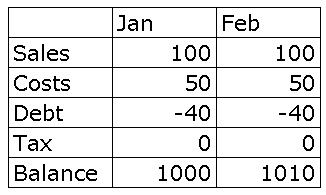
When you see this, you probably don’t understand how it helps your business grow. So you end up forgetting about it. And yes, this table really doesn’t help.
The truth is, managing cash flow helps your business grow, but you need to know how to do it the right way. Let me show you how to make a cash flow plan that actually helps your business grow faster.
Let’s look at a simple example:
- It costs $100 to get one new customer
- Each customer pays $10 per month
- It takes 4 weeks from when you spend money on ads until a customer signs up
- Other costs are 50% of what you sell
Here’s what a monthly cash plan looks like:
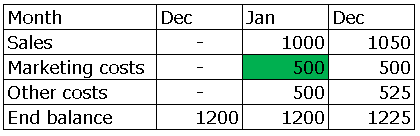
In this scenario, spending $500 on marketing acquires 5 new customers, who will generate $50 in monthly revenue starting the following month.
Initially, it seems your maximum monthly marketing budget is $500. The ending balance shouldn’t fall below $1,200—for a reason I’ll explain.
Your end balance needs to cover two things:
- The bills you need to pay
- A safety cushion for unexpected costs or timing mismatches
Think about it – if you only have $800, apparently you can’t pay $1000 in bills. In this example, next month’s costs will be $1025 ($500 + $525), so you need to keep more than that in your account.
Having extra money for unexpected costs is really important. If your business is stable and you know exactly what you’ll spend each month, you don’t need to keep as much extra, although that is rare.
This extra money helps you handle surprise costs without having to get expensive loans. It’s up to you how much extra to keep – more extra money means less chance of running out, but also less money to reinvest for growth. In this example, they decided to keep $200 extra. That’s why they keep $1200 in the account. If they spend $1025 the next month, they’ll have $175 left ($1200 – $1025), which is close enough to their $200 target.
But here’s where it gets interesting – let’s look at it week by week:
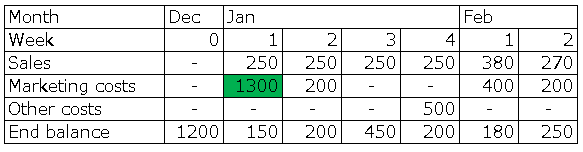
Looking at the weekly breakdown reveals something surprising: you can actually spend $1300 on marketing in the first week – far more than the $500 monthly view suggested. This works because other costs aren’t due until month-end, allowing you to collect several weeks of sales revenue before paying these expenses.
The highest amount they need in the first month is $450, right before they pay the costs. So they don’t actually need to keep $1200 all the time.
This is the key to growing faster: by spending more money earlier, you get more customers sooner. These customers then give you more money to spend on getting even more customers. When you keep doing this, your business grows much faster, and you still won’t run out of money.
That’s what smart cash management is really about – knowing exactly when you can spend more to grow faster, while making sure you’ll have enough to pay your bills.