4 Reasons VCs Ghost Startups — and How to Make Yours Irresistible

Startups are often ghosted by VCs. This happens because VCs have many companies to meet, and most startups are “almost great.” “Almost great” is not good enough to get funded.
I will explain how to fix this to make VCs chase you.
Basically, VCs are speed chasers, as you know. They like things that grow fast more than anything else. This is, of course, because they can sell at much higher valuations when your company becomes 1000 times bigger than it is now.

VC (velocity cat)
So you want to identify what blocks your growth to make your company more attractive. Here are the 4 things:
- Selling products/services at commodity prices
- Having no scalable channel (a channel that brings stable revenue growth as you invest your cash)
- Slow pivoting when reaching limits
- Low revenue growth rate
When the selling price is low, it becomes difficult to find channels where your sales price covers the cost of customer acquisition. So you can’t grow through a reinvestment cycle, which generates compound effects (I will explain this later). But startups often keep doubling down until they reach their limit without pivoting. As a result, sales plateau. After the plateau, it becomes difficult to get funded.
I will explain each of these issues.
In this article, I don’t consider cases like a quantum computing company, where the venture has no revenue but VCs think it has big potential, so they invest heavily.
Problems that block your growth
1. Selling products/services at commodity prices
When a company’s solution produces nearly identical results to its competitors, it has to sell at lower prices. This is because price becomes the only differentiating factor, so companies have to compete on price.
This makes it difficult not only for customers but also for investors to distinguish a company from other companies. As a result, the company becomes less hot.
And by selling low, the profit margin becomes low too. A company with lower profit margins is a less attractive investment for VCs.
For example, compare the following 2 scenarios:
Scenario A: Your company buys inventory at $100 and sells it for $110. Then you reinvest the $110 to buy inventory and sell it for $121. The profit margin is 9%. By repeating this cycle 10 times a year, your company gets $11,794 in the third year.
Scenario B: You buy at $100 and sell it for $120. The profit margin is 16.6%. Repeating this 10 times a year, the sales become $119,423 in the third year.
In this case, a 7.5% margin difference makes sales 10 times bigger in 3 years. Not only profit margin, but also how many times you go through the reinvestment cycle determines your growth. I summarize this as the Growth Efficiency Formula.
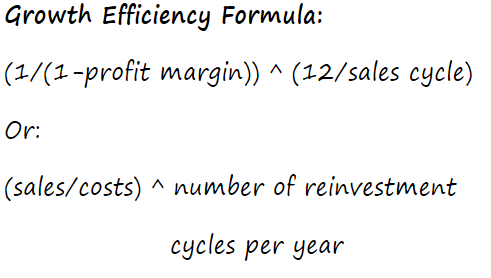
The former option’s efficiency is 1.1^10 = 2.59. The yearly revenue growth is 259%. On the other hand, option B’s efficiency is 6.19.
This means higher efficiency shows you can use VC cash efficiently to scale your company. The same amount of investment brings bigger growth. That is why they compare revenue growth efficiencies across companies when they choose investments.
For example, Airbnb founders secured a 30% share of the company after IPO with a valuation of $80B. This is a very high percentage because they didn’t have to give up a big chunk of their share to secure a significant amount of cash, thanks to its high valuation. And that high valuation is due to its high growth efficiency. They achieved high growth using a relatively small amount of funding.
On the other hand, Netflix is a much less efficient company, whose founders have only 1.3% worth of Netflix’s valuation.
So price affects your company valuation, your share of the company, and your net worth.
Not only that, if you are selling at a low price, it becomes difficult to find channels where CAC (customer acquisition cost) is less than gross profit (sales – cost of sales).
Every time you sell, you lose a bigger amount of cash. This doesn’t work, and this leads to the second point.
2. Having no scalable channel
A scalable channel is a place where you put your money, and the revenue expands as you reinvest more in the channel. This works the same as compound interest. Just like 10% compound interest makes your $100 investment worth $1.3M in 100 years. Businesses grow through the cycle: invest your cash, get more cash, reinvest the bigger amount of cash, get bigger cash and repeat.
Of course, the return must be bigger than the investment. If CAC > gross profit, apparently you can’t use this channel. You can use very limited channels in this case. If you are selling at $10, it becomes difficult to use a paid channel like Google Ads because one click costs at least $3. Not all clickers become paid customers. Sometimes, only 1 in 100 clicks becomes a lead. It becomes impossible to pay the ad fee. So you must use inbound marketing like SEO or blogs. It’s a cheap channel, but you can’t control how many will come to you.
Having only inbound marketing channels and waiting for buzz is just relying on luck. You can’t use VC cash effectively in this case. Maybe you can make your product better by putting the VC cash into development, but that doesn’t promise it will bring more revenue.
If you have a scalable channel already, it becomes much more certain that the investment will bring growth. Hence, the investment success rate for VCs increases.
But many startups just keep doubling down on what is working now. Their inbound channel is bringing a steady amount of customers. Why do they have to go outbound?
But it will eventually reach the limit as you grow the channel. And what if the upper limit is not high enough? This leads to point 3.
3. Slow pivoting when reaching limits
Don’t worry, VCs still invest in you even when the potential market of your niche or channel is not big enough. That depends on your team’s ability. If the team can pivot or expand into another niche before the revenue hits the limit, it’s no problem. But the point is whether your team has the ability to pivot.
Leaders must pivot way before reaching a limit to scale smoothly.
4. Low revenue growth rate
As a result of these issues, the revenue growth speed declines. It becomes very difficult for ventures to get funding without a high growth rate.
100% growth a year is good, 60% is “almost there,” 30% needs more boost. You need cash to boost your growth, but to get cash from VCs, you need to boost your growth first.
This seems to be a catch-22 situation. But you can grow without funding by fixing points 1 to 3.
Normal solutions don’t work
1. Sell more at a low price
Sales is calculated by price × quantity. So even when selling at a low price, if you can increase the selling amount, you can grow fast, right?
Big companies have tremendous cash and resources. Competing with them on price is very tough, especially for small businesses.
Also, when you sell at low prices, the profit margin becomes low, so the reinvestment amount becomes low too. So you can’t bring in many customers by reinvesting.
2. Try new channels
You can just try a new channel to acquire customers by mastering marketing. But if the selling price is low, you can only use very low-cost channels.
And it’s very tough to make low-cost channels work. Some can be very successful like Gary Vaynerchuk, but since everyone tries to use zero to low-cost channels, it becomes very competitive. If you are a genius and very lucky, you can make it work.
3. Pivoting when you hit a wall
It takes a long time to make an investment work, like a new channel or a new niche. So if you wait until you reach the market’s upper limit and finally pivot, your growth stops until the new investment works. VCs like things that grow steadily. To accomplish that, pivot way before you hit the limit.

4. Getting VC funding without fast revenue growth
Some companies got funded without showing revenue growth first. Even when they have no revenue, they get funded like Airbnb or Snowflake. That is very rare. Also, at each funding round, you have to show significant growth in your revenue from the previous funding round. To get funded without revenue, you have to be very lucky, spend a significant amount of time securing funding while getting tons of rejections, have great connections to the business industry, have past successful venture achievements, and your business must be very unique and appealing to VCs’ eyes.
I think showing actual revenue growth and getting negotiation power is much more certain, and you get a higher valuation. This is the way to secure your share.
The Solution
So here are my solutions.
1. Targeting a niche is very important to sell at a high price
The more niche, the higher price you can charge. But if the result you provide is almost the same as a generic solution, people don’t pay a high price even if you are aiming at a niche.
For example, if you are providing an image creator platform for SNS, that is aiming at a niche rather than more general products that you can use for anything. But if the images created by both of them are identical, that doesn’t provide value even if they are focusing on a niche.
The result must be either: a) look like all the images are created by a professional or b) the post with the image created on the platform goes viral at a much higher rate. The platform owner must have the know-how of creating images that accomplishes those things. (If you don’t have it, you must learn.) Integrate the know-how into the platform, so users can automatically generate those images using your platform. That is the unique value only you can provide. No rival general products can provide this. Because your solution only works for the niche.
That is the value. And by providing value, you can raise your price. Focus on the result your customers get. By comparing your platform to a professional image creator’s work, you can charge like 10 times more for the niche.
2. You can unlock more channels once you can charge more
Then you can put your business on the path of compound growth.
To charge higher, you can also use upselling, cross-selling, or seat expansion. The point is average gross profit per customer should be higher than CAC.
3. You have to pivot before you reach the limit of your niche or channel
To accomplish this, you have to guesstimate the market capacity of the niche or channel. Guesstimation is guessing an unknown number by using available data. For example, if your channel is SEO and search volume is 10,000 a month, and 10% click and 10% become leads and 30% buy it, the limit is 10,000×10%×10%×30%=30/month. If you are guesstimating your niche market’s limit, you can read this article to know how to do that. If you know it beforehand, you can pivot way before revenue reaches that.
Conclusion
By doing those 3 things right, you can grow your business fast. Having high price and high profit margins first, then you can use many channels. And expand into those as you grow. Pivot before reaching the limit. Grow your business fast using compound effects even when VCs don’t fund you. Don’t chase VCs, make VCs chase you.