Cash Flow Problems? One Idea Built $100B Business Without Capital


Running a small business often means watching cash disappear faster than it comes in. You pay suppliers before customers pay you. You stock inventory before you make a sale. Every gap in that cycle is a cash flow problem — and it kills more businesses than bad products ever do.
The good news: this is a solvable problem. The solution isn’t to raise money or cut costs — it’s to redesign how money moves through your business. And nobody did this better than Dell.
Dell built a $100 billion empire without relying on investor cash — and with far less dilution than most founders take on. That’s why Michael Dell became one of the richest people in the world. The secret wasn’t a superior product — it was mastering something called the Cash Conversion Cycle.
What is the Cash Conversion Cycle?
Imagine you buy $100 worth of inventory today. Until a customer buys it and pays you, that $100 is gone. You can’t use it. You can’t pay rent with it. You can’t hire anyone with it.
That frozen period — from the moment you pay out to the moment cash comes back in — is the Cash Conversion Cycle.
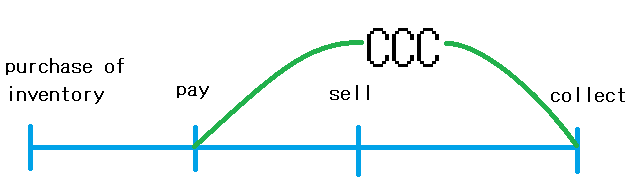
The longer it is, the more cash is stuck inside your business at any given time.
Here’s what makes this painful: when sales go up, the problem gets worse. More sales means more inventory, which means more cash frozen before it comes back. This is why fast-growing businesses so often run out of money. Growth doesn’t feel like it should cause cash problems — but it does.
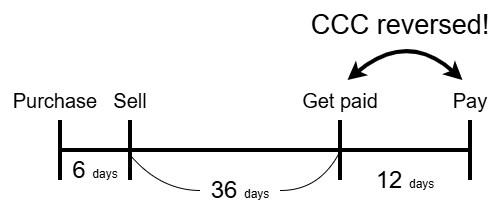
Now imagine flipping that around.
That’s a negative Cash Conversion Cycle — and that’s exactly what Dell engineered.
How Dell Made the Cycle Work
Dell disclosed its CCC figures publicly in its annual reports — unusual for any company, but Dell was proud of the numbers. Here’s how they achieved it across three areas.
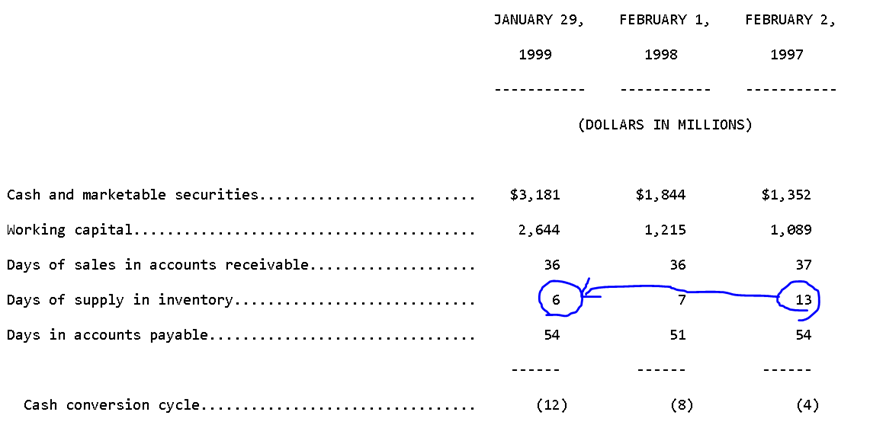
From 10-K (Days of supply in inventory significantly improved in 2 years)
Accounts Receivable
Surprisingly, 90% of Dell’s clients consist of institutions. Even with direct selling, institutions don’t pay with cash or credit. They pay later, and it becomes receivable to Dell. Hence, DSO (period from sale to receivable collection) is 36 days.
This is short compared to rivals. In 1999, Compaq had 63 days, and HP (Hewlett-Packard) had 51 days. 36 days is short. I guess Dell used its very low price in payment term negotiations, like “our PC is very cheap, no rival company can provide at this price, so pay the bill faster.”
If you’re providing truly unique value to customers, you can use it in negotiations too.
And of course, its direct sales (not retail sales) model contributed to short DSO. Dell gets paid with cash or credit immediately from individual customers.
By the way, if you want to know more about CCC, please read my CCC article.
Accounts Payable
DPO (the number of days from purchasing a product to paying for it) needs to be long. Dell’s DPO was 54 days. Rivals had: Compaq 41 days, HP 30 days. If Dell’s DPO were only 41 days, the CCC would be positive — which is bad, since the goal is a negative CCC. So Dell needed to push it even longer. But how?
Only a handful of vendors
Dell said in an interview, “Working with a handful of partners is one of the keys to improving quality.”
Dell works with a small number of suppliers. By offering them the chance to sell large volumes of parts, Dell gains the leverage to negotiate longer payment terms — which is the key reason DPO is so long.
Give more advantages to vendors
On top of that, Dell shares data with vendors to help them predict demand more accurately. Because Dell sells directly to customers without going through retailers, demand is much easier to forecast. And since inventory moves very fast, only short-term forecasting is needed.
Think of it like weather prediction — a weekly forecast is far more accurate than trying to predict the weather three months out.
Dell gave suppliers access to its real-time data, which helped them avoid building up excess inventory — a huge advantage for vendors.
Very Little Inventory
Inventory is the most critical piece of the puzzle. Compaq held 19 days, HP 42 days — already low, but Dell’s 6 days was extraordinary.
Low inventory doesn’t just make CCC negative. In the PC industry, it’s a survival strategy.
Unsold inventory leads to write-offs that eat into profits. In most industries that’s painful — in the PC industry it’s especially dangerous, because products go obsolete fast. Consumers hesitate to buy a PC when they know a faster model is coming within a year. This is Moore’s Law: processing power doubles roughly every year, while microprocessor costs fall. Any inventory sitting on a shelf is losing value by the day.
So how did Dell keep inventory so low? Three reasons.
Demand prediction
Dell’s demand forecasting was highly accurate, which eliminated the need to stockpile “just in case.”
No order, no production
Dell purchased components but only assembled PCs after receiving a customer order. Since you can’t know which PCs will sell until an order arrives, this eliminated dead stock of finished PCs entirely. The key was assembling fast. Dell made several improvements to do that:
- Designed PCs to be easy to assemble
- Reduced the number of components
- Pre-installed Windows 98
- Used fast internet connections to download software quickly
Smaller, more frequent inventory
JIT (Just-In-Time) means receiving only what you need, exactly when you need it. Dell’s suppliers delivered as frequently as every 2 hours.
Here’s why it matters. Say a company sells 365 units a year at $1,000 each. If they receive stock twice a year, they need $182,000 upfront — and that cash sits locked in inventory for 6 months before it’s recovered through sales.
With JIT, the same company receives and sells one unit per day. They only need $1,000 in capital at any time. That cash turns over daily — available to reinvest in sales, marketing, or anything else. And if demand shifts, the dead stock exposure is just $1,000, not $182,000.
The tradeoff: bulk buying often comes with discounts. If you have strong cash reserves and low dead stock risk, buying in bulk can make sense. But if cash is tight, JIT wins.
Dell’s JIT was extreme even by industry standards:
- Suppliers had to locate their warehouses within 15 minutes of Dell’s factory
- Suppliers had to deliver at least every 2 hours
Suppliers accepted these demanding terms because Dell offered something in return: guaranteed large volumes and predictable demand. A tough deal — but a fair one.
The JIT mindset applies beyond physical goods too. Pay for marketing on a performance basis rather than upfront. Pay commissions in installments. Avoid locking cash into annual subscriptions when monthly options exist. The principle is the same: keep cash flowing, don’t let it sit idle.
Cash Allocation Mistakes for Dell
Dell is a great company focusing on hardware business operations, making it one of the most efficient businesses ever. But it failed to invest its cash in new innovation to create future cash flow.
Sales decreased after Chinese and Taiwanese companies entered the industry and sold cheaper PCs than Dell. Dell’s only strong point was pricing, but nobody can beat China on price.
This is a typical innovator’s dilemma. Here’s what happened: Dell wanted to invest its cash wisely, but outside of hardware, Dell couldn’t tell what would be profitable — and many times, new investments were very unprofitable. So they concluded that investing in innovation wasn’t worth it, and focused only on operations.
They only realized the need for innovation after the Chinese invasion happened. Before 2005, R&D spending was only around 1% of sales, and cash just piled up. It was a cash allocation disaster.
The result was a stock price plunge from $40 in 2005 to $13 in 2013. The price was so low that Mr. Dell bought out the company’s stock and took it private.
After that, Dell’s investments finally succeeded. The company went public again in 2018, and its new business in cloud computing has been very successful.
Even with this cash allocation mistake, the genius inventory and CCC strategy made him the 10th richest person in the world.
Cash short? Cash flow specialist CPA offering free consultation.
Book Free 10-min Expert Session