Asset Rationalization: The One Thing That Kills Your Business

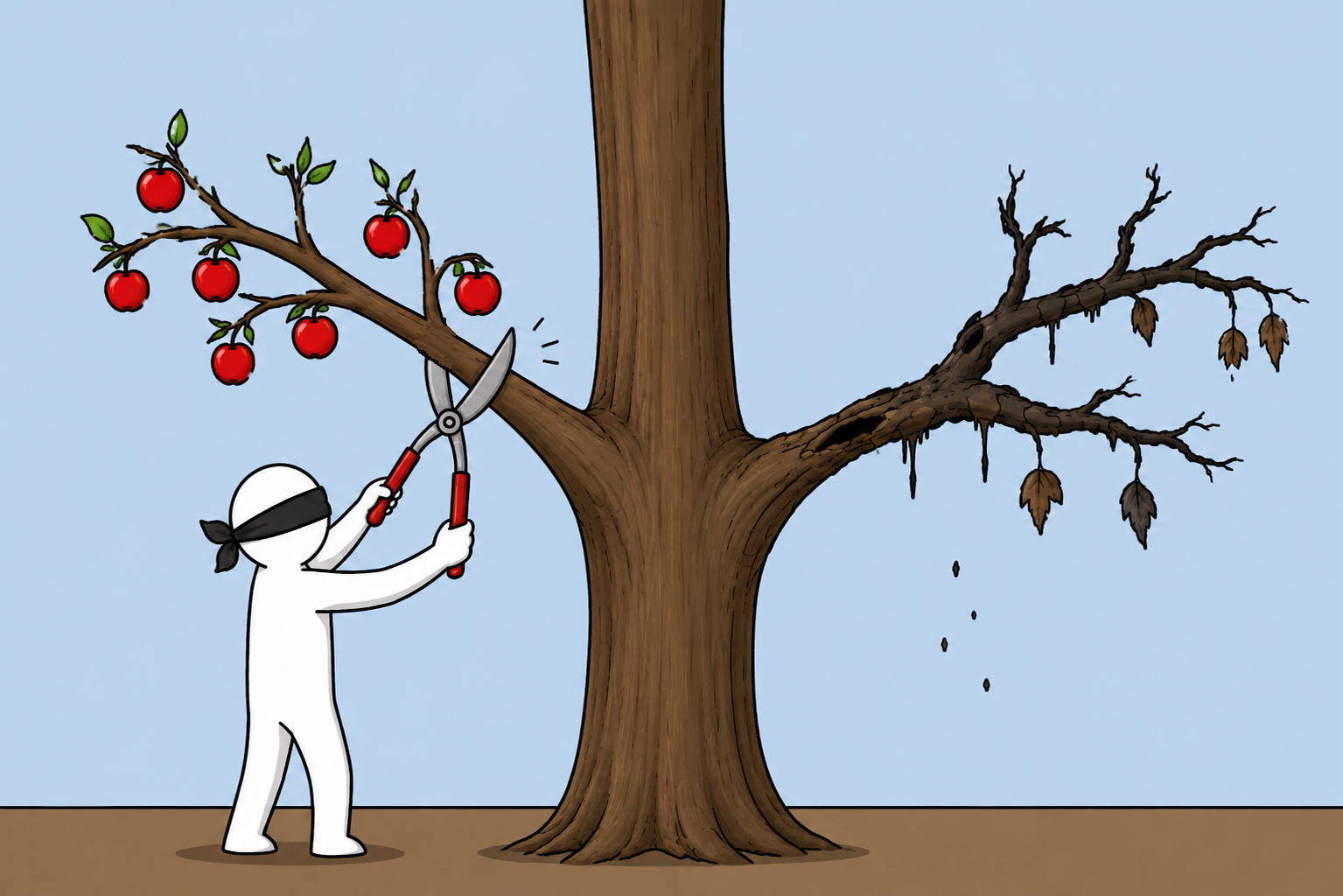
When cash is tight, selling off assets can feel like the obvious fix. A piece of unused equipment, an underperforming product line, a second location that isn’t pulling its weight, get rid of it, pocket the cash, breathe easier.
This process even has a name in corporate finance: asset rationalization, the practice of reorganizing what a company owns and operates to improve efficiency and strengthen the bottom line.
On paper, it sounds like discipline. In practice, it’s one of the easiest ways for a small business to accelerate its own decline.
The standard definition of asset rationalization covers a range of moves: selling off assets, closing a location, expanding a location that’s doing well, or streamlining how operations run.
It’s also well known that this process often comes with a real human cost: cutting staff, closing sites, and ending contracts.
Critics have long pointed out another problem. Rationalization often chases a short-term win on the balance sheet while damaging parts of the business that were still working.
As a result, the remaining staff and operations are left under more strain, not less.
That criticism is correct, but it usually stops one step short of the real explanation.
Rationalization doesn’t damage healthy parts of the business by accident, or simply because cutting anything is inherently risky. It happens because the decision about what to cut was made without knowing, accurately, what each part of the business actually costs to run.
Fix that one input, and the whole risk changes shape.
Why “Obvious” Cuts Are Often Wrong
Here’s the uncomfortable truth: even large, publicly listed companies with finance departments and audit committees frequently misjudge which assets or business lines are actually losing money.
If sophisticated corporations get this wrong, a small business owner making a fast decision under cash pressure is at even greater risk.
The mistake almost never happens on the revenue side. Sales are easy to measure, money either came in or it didn’t.
The real danger sits in how costs are divided up across the business. Profit is simply sales minus costs, but “costs” is where most rationalization decisions quietly go wrong.
A Quick Explanation of Cost Allocation
You don’t need an accounting background to follow this, so here’s the short version.
Most businesses don’t track the exact cost of every single product, service, or customer. Instead, they use a simple rule to spread shared costs, things like rent, management salaries, utilities, or equipment depreciation, across everything the business does.
The two most common rules are:
- By sales: if a product makes up 30% of your total sales, it gets charged 30% of the shared overhead.
- By direct labor hours: if a job takes up 30% of your team’s total working hours, it gets charged 30% of the shared overhead.
Both are fast and easy to calculate. Both are also frequently wrong.
Sales-based allocation punishes your best-selling, lowest-hassle products by loading them with costs they didn’t really cause.
Labor-hour allocation ignores everything that isn’t direct labor, machine time, storage space, customer support calls, delivery costs, returns processing, which can be huge for some products and almost nothing for others.
So a product or service can look unprofitable simply because of how costs were divided, not because it’s actually losing money.
And the reverse is just as common: something can look fine on the surface while quietly being the actual source of your losses.
How Bad Cuts Turn Into Bigger Losses
This is the part that catches business owners off guard: cutting the wrong asset doesn’t just fail to help, it can actively deepen the crisis.
The core problem is simple: without accurate cost accounting, you genuinely don’t know which parts of your business are profitable and which are losing money.
So when you decide what to cut, you’re guessing. And if you guess wrong, you shut down an operation that was actually healthy, one that was generating real profit, while the operation that was actually losing money stays untouched.
The result is that your business is now smaller, but the problem that was dragging it down is still there.
You’ve lost good revenue and kept the bad. Costs that used to be spread across more sales now have to be covered by less, so the business looks even weaker than before.
This is how a business under cash pressure can go from “tight” to “insolvent” within a year or two of a decision that looked completely reasonable at the time.
The tragedy is that it was avoidable, not by refusing to cut anything, but by cutting the right thing.
The Bad Way vs. The Good Way to Raise Cash Through Asset Sales
The bad way most business owners approach this: you need cash, so you look around for something that seems idle or non-essential, sell it, and get the money.
The problem is you’re guessing. Maybe that “idle” piece of equipment was actually backing up a busy season. Maybe closing that “slow” location was quietly subsidized by a nearby one and now both suffer.
You get the cash, but you have no real way of knowing whether you just made a smart move or set off a chain reaction.
You find out which one it was months later, when it’s too late to reverse.
The good way starts from the opposite direction.
Before you decide what to sell, you first figure out which operations are actually causing losses.
That means calculating real profitability, not by sales or labor hours, but by looking at each item, service, sales channel, or customer group individually and tracing the true costs each one causes.
Once you know which operations are genuinely losing money, the decision changes shape entirely.
You’re no longer asking “what can I sell for quick cash?”
You’re asking “which unprofitable operation should I stop, and only then, what assets tied to that operation can I safely sell, now that I know stopping it won’t take a healthy part of my business down with it?”
That order matters.
Sell first and you’re gambling. Diagnose first and the asset sale becomes a safe, logical next step instead of a leap of faith.
A More Accurate Way to Find the Real Cost: Activity-Based Costing
The method behind this good-way approach is called Activity-Based Costing, or ABC.
Instead of spreading overhead by sales percentage or labor hours, ABC traces costs to the actual activities that create them, how many customer service calls a product generates, how much machine setup time it needs, how often it gets returned, how much shelf space or storage it eats up.
Two products with identical sales can have very different true costs once you look at it this way, and that’s usually where the surprises show up.
Get the Full Picture Before You Cut Anything
Asset rationalization can be exactly the right move, but only when it’s based on an accurate picture of profitability, not a quick guess about what looks idle.
Selling the wrong asset under cash pressure has ended businesses that could have been saved by a different decision entirely.
It’s also worth knowing that asset rationalization is just one of several ways a business can unlock cash.
Depending on your situation, there may be other places to free up money that carry far less risk, before you touch a single asset.
As a cash flow specialist CPA, I offer a quick, no-obligation estimate of how much cash could realistically be unlocked in your business, through asset rationalization and other areas, so you can see where your real opportunities are before committing time or money to any one path.
Get a quick, no-obligation estimate of your cash unlock potential before making any major decisions.
Click Here for Your Rough Estimate Now