Profitable But No Cash? Here’s Why — and 2 Ways to Fix It

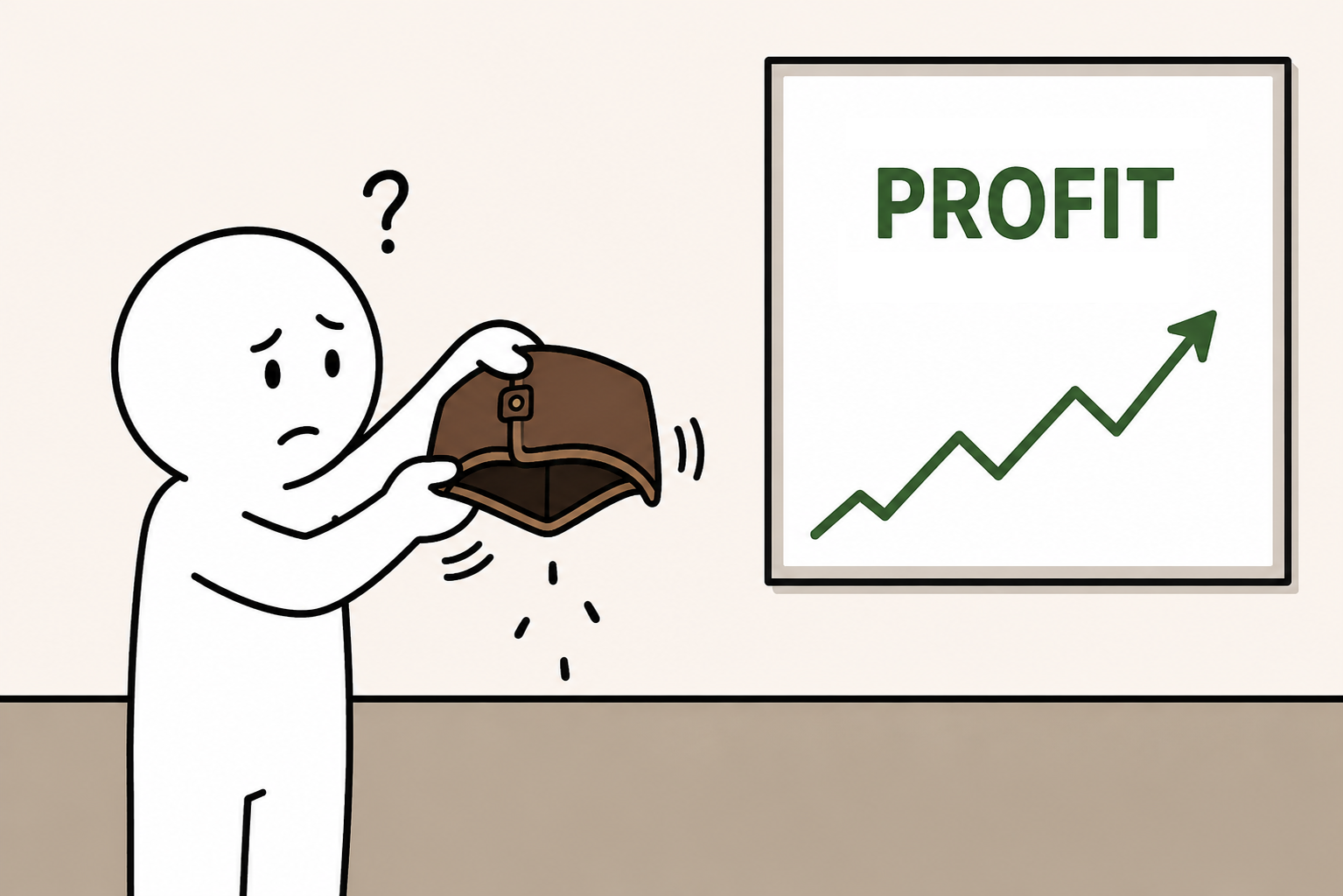
You checked your P&L. It says you made a profit this year.
Then you checked your bank account. The number doesn’t match.
Maybe it’s lower than last year. Maybe there’s barely anything left to pay yourself.
If you’re asking “why am I profitable but have no cash,” you’re not doing anything wrong, and you haven’t made an accounting mistake.
This is one of the most common — and most misunderstood — problems in business.
Let’s break down why it happens, in plain terms, and two practical ways to fix it.
First, Why Profit and Cash Are Not the Same Thing
This confuses almost every new business owner, so let’s slow down here.
Profit is an accounting number. It’s calculated as Revenue minus Expenses, based on when a sale is earned — not when the cash actually lands in your bank account.
If you sell $10,000 of product today but the customer pays you in 60 days, that $10,000 counts as revenue today, even though you haven’t received a single dollar yet.
Cash is simply what’s sitting in your bank account, available to spend right now.
A business can be fully profitable on paper and still run out of cash to pay rent, payroll, or suppliers.
That’s because profit is earned before cash is collected, and because money often has to go out the door — buying inventory, equipment, paying deposits — before it can come back in as a sale.
That gap between earning profit and collecting cash is where businesses get into trouble.
The #1 Reason: You Are Growing
Growth is supposed to be the goal.
But growth is also the single biggest reason profitable companies run out of cash.
Here’s why: to make more sales, you first need to build the capacity to support those sales.
That usually means spending money before the new sales revenue arrives — on things like:
- Inventory — you have to buy the products before you can sell them.
- Receivables — you deliver the product or service, but the customer doesn’t pay for weeks or months.
- Equipment and space — a bigger operation often needs more machines, tools, or square footage.
That spending happens first. The cash from the extra sales comes later, if at all in the short term.
In accounting terms, you’re converting cash into assets — inventory, equipment, unpaid invoices — before those assets convert back into cash.
A Simple Example
Imagine you run a retail store, and you want to double your sales by opening a second location.
The new store adds $100 in profit this year.
But opening it cost you $1,000 — for buildout, fixtures, and initial inventory.
Net result for the year: -$900 in cash, even though your profit went up.
On paper, in your P&L, you’re more successful than ever.
In your actual bank account, you’re worse off than before you expanded.
This Is a Universal Truth
This is not a sign of bad management, and it’s not unique to your business.
Every growing company goes through this.
Inventory piles up before it sells. Receivables grow before customers pay. Equipment gets purchased before it generates a return.
The faster you grow, the wider this gap gets.
The good news is that this gap is predictable, and it can be managed.
Here are two ways to do it.
1. Achieve a Negative Cash Conversion Cycle (CCC)
The Cash Conversion Cycle (CCC) measures how many days your cash is “stuck” in your operations — from the day you pay for something, like inventory, to the day you finally collect cash from a customer for it.
Think of it as a stopwatch that starts the moment cash leaves your hands and stops the moment cash returns.
The formula:
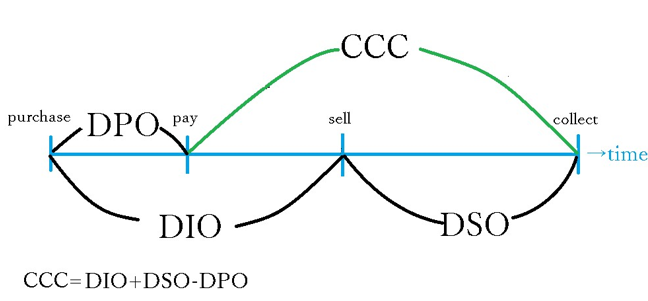
CCC = Days Inventory Outstanding + Days Sales Outstanding − Days Payable Outstanding
In plain English:
- Days Inventory Outstanding (DIO): How many days, on average, products sit in inventory before they’re sold.
- Days Sales Outstanding (DSO): How many days, on average, it takes customers to actually pay you after a sale.
- Days Payable Outstanding (DPO): How many days, on average, you take to pay your own suppliers.
Most growing companies have a positive CCC — meaning they pay suppliers, sit on inventory for a while, wait for customers to pay, and only then have real cash back in hand.
The longer that cycle, the more cash growth eats up, because more of your money is tied up and unavailable at any given time.
A negative CCC flips the equation.
It means you collect cash from customers before you have to pay your own suppliers.
Instead of growth draining your cash, growth can actually fund itself — and in some cases generate extra free cash along the way.
This is one of the reasons some fast-growing companies can scale aggressively without running out of money.
How to move toward a negative CCC:
- Shrink DSO — collect from customers faster. Ask for deposits, shorten your payment terms, or tighten up your collections process.
- Shrink DIO — turn inventory faster. Avoid overstocking, and order closer to when you actually need the goods.
- Extend DPO — negotiate longer payment terms with your suppliers, without damaging the relationship.
2. Find and Cut the Sales That Are Draining You
Here’s an uncomfortable truth: not all of your sales are good sales.
Some of them are quietly costing you money, even while your overall P&L shows a profit.
According to research based on activity-based costing, popularized by Harvard professor Robert Kaplan, a typical business’s sales tend to break down roughly like this:
- About 20% of sales generate the majority of your profit.
- About 60% are barely profitable — they cover their costs, but add little.
- About 20% actively drag the business down, sometimes at a real loss.
In other words, a large share of what you sell may not be making you meaningful money at all.
And some of it may be losing money outright, hidden inside a P&L that still looks profitable overall.
Why You Can’t See This on a Normal P&L
A standard P&L only shows totals: total revenue, total cost of goods sold, total expenses.
It doesn’t break down which specific product, service, customer, or sales channel is actually profitable versus which one is quietly losing money.
Two customers can generate the exact same revenue, and one can be highly profitable while the other loses you money.
That’s because of the different amount of time, support, inventory, or shipping costs each one requires.
To see this clearly, you need to calculate the true cost of each item, service, customer, or channel — not just company-wide averages.
A Simple Way to Do This: Activity-Based Costing (ABC)
Activity-Based Costing (ABC) is a method of assigning costs based on what actually drives those costs, instead of spreading them evenly across everything you sell.
Here’s the idea in plain terms.
Most businesses calculate cost per product using rough averages — for example, dividing total overhead by total units sold, and adding that flat amount to every product’s cost.
The problem is that not every product uses the same amount of resources.
A product that requires more handling, more customer support calls, more storage space, or more shipping steps should carry more of the cost — but a simple average won’t reflect that.
ABC works differently. It follows three basic steps:
- Identify the activities involved in delivering your products or services — for example, order processing, warehousing, quality checks, customer support, and shipping.
- Determine what drives the cost of each activity — for example, the number of orders processed, square feet of storage used, or number of support tickets handled.
- Assign costs to each product, service, or customer based on how much of each activity they actually use — rather than spreading costs evenly across everything.
The result is a much more accurate picture of true profitability at the individual product, service, or customer level — not just at the company-wide level.
Why This Matters
Without this level of detail, you’re essentially flying blind.
You might be pouring more marketing budget, more staff time, and more inventory into a “big customer” or “popular product” that’s actually losing you money once you account for everything it truly costs to deliver.
Meanwhile, a quieter, smaller line of business might be your most profitable one — and you wouldn’t know to protect or grow it.
Once you know which products, customers, or channels are truly losing money, you have a clear decision to make:
Fix the pricing, renegotiate the terms, reduce the cost to serve them, or cut them entirely.
Cutting bad sales can unlock cash that was previously trapped supporting a part of the business that was never actually helping you.
The winning businesses are the ones constantly finding their draggers, cutting them, and reinvesting in the next winner.
“`htmlHow Much Cash Could You Actually Unlock?
Activity-Based Costing can reveal which products, services, or customers are dragging your business down.
But implementing ABC properly can require a significant amount of time, data, employee involvement, and professional work.
Before investing that much money and effort, there is a more basic question you should answer first:
How much cash could you realistically unlock?
If the opportunity is small, an expensive ABC project may not be worth pursuing.
But if the potential cash unlock is large enough, then a deeper analysis may make sense.
That is what my rough estimate is designed to help you determine.
As a cash flow specialist CPA, I estimate how much cash your business could potentially unlock before you commit to a much larger project.
Get a rough estimate before investing in a costly analysis or implementation project.
Get Your Rough Estimate →