Unveiling the Secrets of Deckers’ 1000X Investment Jackpot

Want to know how to make your company 1000 times bigger? Well, one company has actually done it, and we can learn from their amazing story. Let’s talk about Deckers.
Deckers is a shoe company, they own several popular shoe brands you might know: Ugg, Hoka One One, and Teva. Right now, Hoka One One is their rising star, growing incredibly fast.
Let me show you something mind-blowing. If we compare the S&P 500 and Deckers’ stock prices (starting from January 1, 2000), the difference is incredible. The S&P 500 grew 3.7 times by April 2024 – pretty good, right? If you had invested $100,000, you’d now have $370,000. Not bad at all!
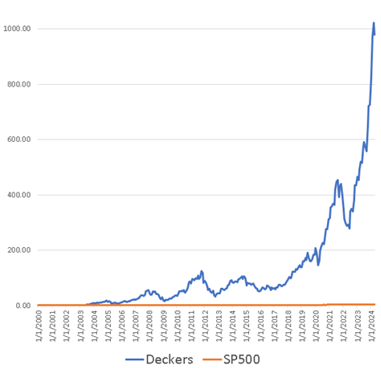
But here’s the crazy part: Deckers’ stock didn’t just grow – it exploded, becoming almost 1000 times bigger in just 23 years! That same $100,000 investment would have turned into $100 million. Yes, you read that right – million! Wondering how they pulled off this miracle? Let me break it down for you.
Three main things made Deckers so successful: smart brand acquisitions (M&A), getting bigger and better at what they do (economies of scale), and buying back their own stock (heavy stock repurchase).
1. First, Deckers has an amazing talent for spotting great brands and buying them for bargain prices. Think about this: they bought Teva for $62 million, Hoka for just $1 million (what a steal!), and Ugg for $15 million. Today, these brands are bringing in yearly sales of $180 million, $1.4 billion, and $1.9 billion respectively. That’s what I call a good investment!
These brands also got lucky breaks along the way. Ugg boots got a massive boost when Oprah recommended them on her show. Hoka caught the ‘dad shoe’ wave – you know, when chunky, oversized shoes suddenly became cool after Balenciaga released their Triple S model in 2017. But here’s what’s clever: even after these trends faded, Deckers kept growing because they had multiple successful brands to fall back on.
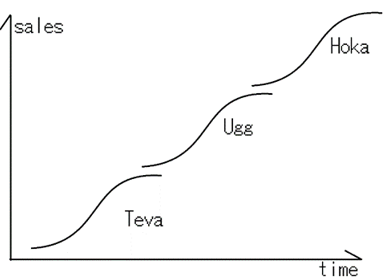
Here’s something interesting: Deckers has always stuck to their guns with ‘ugly’ shoes. All their brands, since day one, have been selling shoes that aren’t exactly winning beauty contests. Even when things looked rough around 2016 and sales weren’t great, they didn’t change course. Instead, they went all in and made even uglier shoes (like the legendary Teva-Ugg hybrid – yes, that was a real thing!). They believed ugly shoes would become fashionable, and guess what? They were absolutely right! Hoka became a massive success story.
Another smart move? Deckers doesn’t own factories – they outsource everything. This makes growing much easier. Think about it: if you own factories and want to double production, you need to build new factories, which costs a ton of money. But when you outsource, you just need to find more manufacturing partners. No huge cash investments needed!
The results speak for themselves: their sales shot up from $111 million in 1999 to a whopping $3,627 million in 2023 – that’s 33 times bigger!
2. Here’s where it gets really interesting – the power of economies of scale. Simply put, as Deckers got bigger, they got better at making money. Let me show you: in 2023, they made $3,627 million in sales with a profit of $516 million – that’s a 14% profit rate. Compare that to 2016, when they made $1,875 million in sales but only $122 million in profit (6.5% profit rate). See the magic? Sales doubled, but profits quadrupled!
Deckers went through some tough times though. From 2013 to 2018, sales barely grew – these were their ‘dark years.’ They had to wait patiently until the dad shoe trend kicked in. But when it did, Hoka took off like a rocket!
Here’s a clever thing about Deckers: all their brands share the same headquarters, sales channels, and business systems – it saves money! While sales go up, many of their overhead costs (what they call SGA – Sales, General, and Administrative expenses) stay pretty much the same because these are fixed costs.
Want proof? Look at their employee numbers. In 2016, they had 3,500 employees. By 2023, even though sales had doubled, they only needed 4,200 employees – just a 20% increase! How do they pull this off? Because they’re mainly a wholesaler with an online shop, not a chain of retail stores. When sales go up, they don’t need to hire tons of new store managers or build bigger websites – everything just scales up smoothly.
The results are impressive: their profit rate jumped from 2.6% in 1999 to 14.2% in 2023 – that’s 5.5 times better!
3. Now, let’s talk about their smart money move – stock buybacks. Deckers bought back 30% of their own stock when prices were low. By ‘low,’ I mean two things: the price-earnings ratio (PER) was low, and the stock price went up after they bought them (talk about good timing!).
Think of it this way: in 2010, there were 38 million shares of Deckers stock. By 2023, there were only 26 million. It’s like a pie – would you rather share it with two people or three? Same pie, fewer slices = bigger pieces for everyone!
Let’s do some quick math: In 2023, they made $500 million in profit. The stock buyback created an extra $160 million in value for shareholders this year. They spent $1,700 million on buybacks since 2012, but it’s been worth every penny.
Here’s a great example: in 2012, they bought 4 million shares at $49 each. The PER was 14 then, meaning it would take 14 years of profits to equal the stock price. That was a bargain compared to today’s price of around $900 with a PER of 32!
Now, buying back stock is tougher because their stock price is so high. But they’re still making lots of cash, so what’s next? I think their best move would be to buy new brands – plant new seeds for future growth, just like they did with Hoka and Ugg.
All these fantastic moves – growing sales, better profit margins, and smart stock buybacks – have made investors willing to pay more for each dollar of earnings (that’s what PER means). Their PER went from about 9 in 2000 to 32 in 2024 – 3.6 times higher!
Let’s put it all together: Sales grew 33 times, profit margins increased 5.5 times, stock buybacks added 1.4 times, and the PER went up 3.6 times. Multiply those together: 33 × 5.5 × 1.4 × 3.6 = 914 times increase in stock price. That’s how you turn $100,000 into nearly $100 million!
Pretty amazing story, right? It shows that with smart brand picks, efficient operations, and clever financial moves, incredible growth is possible – even in the ‘ugly’ shoe business!