How to Pick Prices to Unlock Spectacular SaaS Growth

Why Typical Pricing Methods Don’t Work
Many business owners choose their prices by looking at what their competitors are charging or just going with what feels right. This approach is simple, but it misses something important: how your pricing affects your cash flow and how fast your business can grow.
When you set the perfect price for your products, you can generate the maximum amount of cash from your business. With more cash coming in, you can reinvest more money back into your business (like marketing, product development, or hiring). This reinvestment is what grows your business faster.
A Better Way: Price Testing
Instead of guessing what price to charge, you can use something called a “pricing test.” One of the most well-known methods is the Van Westendorp Price Sensitivity Meter.
Here’s how it works: You send a questionnaire to your customers with four specific questions about pricing. Each respondent answers all four questions. Their answers provide data that helps you find the optimal price point for your product.
The Four Questions in the Van Westendorp Method
The traditional questionnaire asks these four questions:
- Too Expensive Question: “At what price would you consider the product to be so expensive that you would not consider buying it?”
- Too Cheap Question: “At what price would you consider the product to be priced so low that you would feel the quality couldn’t be very good?”
- Expensive/High Side Question: “At what price would you consider the product starting to get expensive, so that it is not out of the question, but you would have to give some thought to buying it?”
- Cheap/Good Value Question: “At what price would you consider the product to be a bargain—a great buy for the money?”
Improving the Third Question
The third question is actually the most important one, but it has a major flaw. When customers say a price is “starting to get expensive,” we don’t know if that means they would still buy it or not. Also, asking when it “starts” to get expensive doesn’t tell us the maximum price they’d pay. The only thing we can know is that they think it’s expensive.
A better version of this question would be:
“At what price would you consider the product to be expensive, but still worth purchasing due to its value or benefits?”
This improved question helps you find the exact price at which customers think “This is expensive, but I’ll still buy it.” Any price higher than that, and they probably won’t buy.
By the way, I once tried a price test on my girlfriend. ‘How much would be an acceptable birthday present to show how precious our love is?’ She answered ‘$2,000.’ I smiled and said, ‘That is very wrong, honey. We can’t put a price on our love—it’s priceless. So “nothing” can show how much it means. Which is why this year, I’m giving you “nothing”…’
She churned at record-breaking speed. Cash-clash!
Analyzing the Results with an Example
Let’s say you own a hair salon and currently charge $60 for a service. You survey 40 customers and get responses like these:
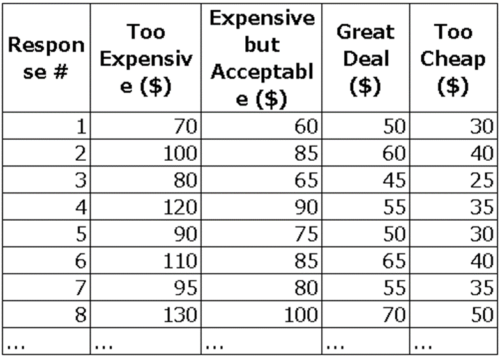
When you graph this data, you can see patterns that help determine the optimal price. You can create this in Excel.
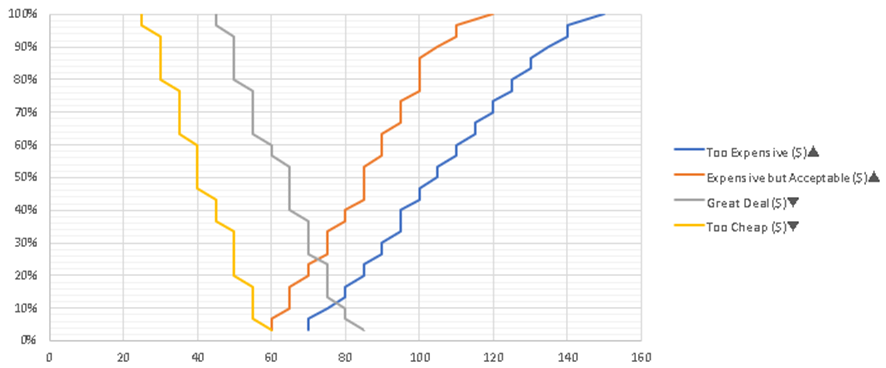
Calculating the “Buy Rate” at Different Prices
The key is to figure out what percentage of customers would still buy at each price point.
For example, let’s look at what happens if you raise the price to $70:
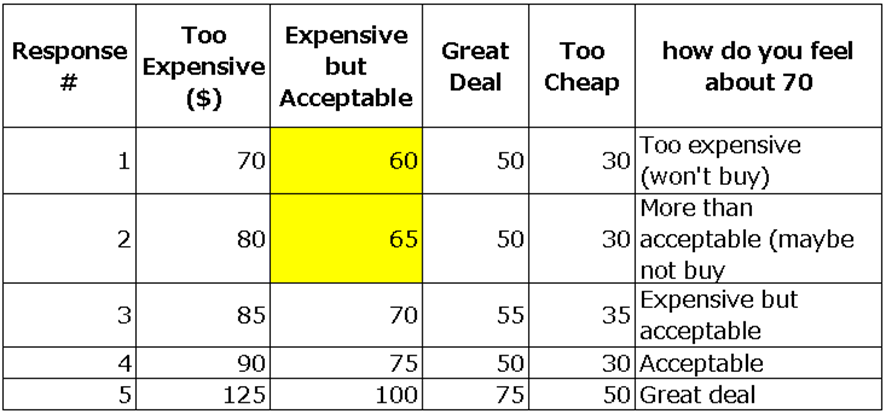
Looking at the “Expensive but Acceptable” column, anyone who listed a price lower than your new price ($70) would probably not buy. In this example, 3 out of 5 people (60%) would still buy at the $70 price point.
So, if this is the result of a price test targeting your existing customers, then raising the price to $70 would cause about 40% of them to churn.
By doing this calculation for several different price points, you can create a table showing the percentage of customers who would buy at each price:
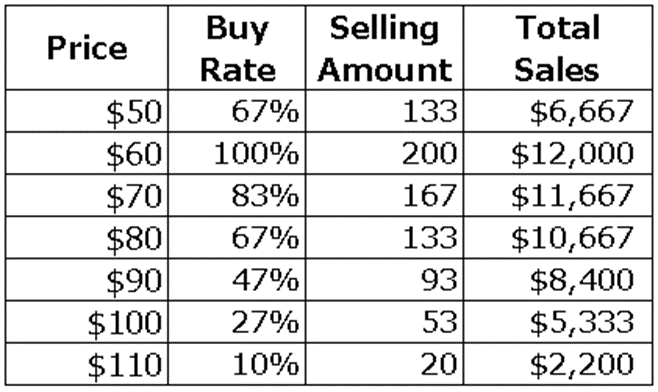
At your current selling price of $60, the buy rate is 100%, and the selling amount represents actual numbers. At $50, the buy rate is lower than the buy rate at $60. Some customers perceive it as too cheap to be high quality, so they choose not to buy.
Using the buy rates from your pricing test, you can calculate the selling amounts and total sales for other price points.
Finding the Most Profitable Price
You might think the best price is the one where “price × buy rate” is the highest (which gives you the highest total sales). But that’s wrong.
The best price is actually the one that generates the most profit and cash flow, which you can then reinvest to grow your business. Your profit depends on your costs.
For example, if your business has:
- Fixed costs of $2000 (rent, equipment, software—costs that stay the same no matter how many customers you have)
- Variable costs of $30 per customer (supplies, commission—costs that do change with sales volume)
Then your profit at different price points might look like:
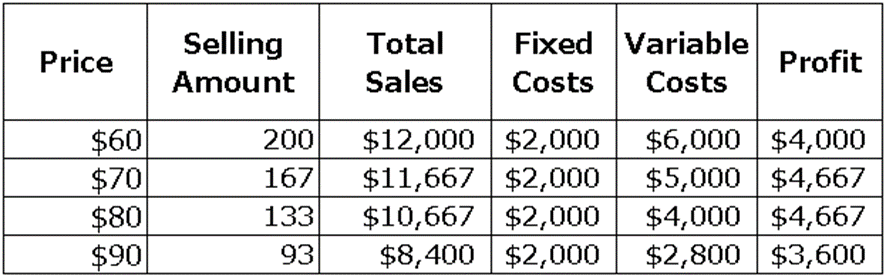
In this example, the $80 and $70 price points generate more profit than $60, despite having lower total sales. Logically, choosing $80 makes the most sense as you’ll have fewer customers, resulting in less work you have to provide.
Also, selling at a higher price often lowers the churn rate. This is because customers tend to be more committed.
At $80, you get lower churn, which is much better than selling it cheaper with a lot more churn.
Final Thoughts
Make sure you consult with your accounting team or CFO before finalizing your pricing decision. Their insights into your cost structure and financial strategy are essential to ensure your new price truly maximizes cash flow to reinvest in growing your business.
Caution: When setting a new price, the buy rate determines how many existing customers will remain. And of course, how many will churn. For example, if you set your price high, and your buy rate is 60%, that means 40% of your existing customers will churn. You should be prepared for unhappy customers.
However, improving your financial situation must be the priority. If you’re providing good value, you should receive what you deserve for it.