Cash Flow Problem? This One Simple Fix Turned $2.5B Disaster Into $800M Cash

The Most Common Cash Flow Mistake
Many small business owners think the solution to a cash flow problem is simple: get more sales. But more sales don’t always improve cash flow. Sometimes they make the problem worse.
If you’re struggling to pay suppliers, worried about payroll, or watching cash disappear despite decent revenue, you’re not alone. Many businesses fail not because they lack customers, but because cash gets trapped inside inventory, receivables, or inefficient operations.
One of the most dramatic cash flow turnarounds in recent history came from an unlikely source.
Carvana went from a $2.5 billion cash-burning disaster to generating roughly $800 million in operating cash flow.
And the lesson applies directly to small businesses. Because if a company facing a catastrophic, multi-billion-dollar death spiral can pull itself back, your business is probably much easier to fix.
A Company on the Brink
Carvana, the online used-car retailer, had become one of the most recognized names in the industry. But by the end of 2022, the company was in serious trouble.
The numbers were grim:
- Cash reserves dwindled to $600 million
- Net loss reached $2.9 billion
- Operating cash flow was negative $2.5 billion
- Debt exceeded $8 billion
Investors fled. The stock price collapsed. Bankruptcy became a real possibility.
Then, in 2023, something remarkable happened. Carvana engineered a stunning turnaround. Costs were slashed, profitability improved, and the company secured critical refinancing that ensured its survival.
Once a $2.5 billion cash-burning disaster, it became an $800 million cash generator.
The stock has surged by 7,600% since then.
The Strange Part: Sales Went Down
Maybe you think the business turnaround happened because sales increased.
It didn’t.
Revenue fell from $13.6 billion to $10.7 billion. Yet profits improved dramatically.
How can a business generate more cash while selling less? The answer reveals an important lesson for any business facing a cash flow problem.
The One Simple Fix: Sell Inventory Faster
Carvana made several operational improvements, but one change mattered more than anything else.
They became obsessed with inventory turnover.
Instead of maximizing selection and pursuing growth at all costs, they focused on stocking vehicles that would sell quickly.
The strategy included:
Laser Focus on Hot Sellers
Carvana concentrated on vehicles with the highest probability of selling quickly.
Rather than carrying every possible option, they prioritized inventory with strong demand.
The Result: Total inventory plummeted from $1.9B in 2022 to $1.2B in 2023, instantly unlocking a massive chest of liquid cash.
Rightsizing Operations
With lower sales volume came lower operating expenses.
Selling, General and Administrative (SG&A) expenses naturally declined because fewer vehicles required fewer employees, facilities, logistics resources, and marketing spending.
The Result: They cut those ruthlessly and stopped the internal cash bleed.
Faster Sales, Higher Profit
The biggest surprise was that selling cars faster increased profitability.
Carvana’s gross profit rate on retail vehicle sales jumped from 3.6% in 2022 to 9.9% in 2023.
Less inventory sitting around meant fewer discounts and fewer losses.
The result was dramatically improved cash flow, too.
Why Inventory Can Cause a Cash Flow Problem
Many business owners underestimate how much cash gets trapped in inventory.
Every product sitting on a shelf represents money that cannot be used for payroll, rent, marketing, debt payments, or growth.
The longer inventory sits:
- The more cash gets locked up
- The greater the storage and handling costs
- The higher the risk of discounting
- The lower the eventual profit margin
In the used-car industry, this effect is especially brutal.
A car that sits for months often requires increasingly aggressive discounts to move. Time literally destroys profit.
The Data Behind Carvana’s Turnaround
The relationship between inventory turnover and profitability was exceptionally strong.
Looking at quarterly results from 2017 through 2024, Carvana’s Days Inventory Outstanding (DIO) showed a strong negative correlation with gross profit margins.
The correlation coefficient was approximately -0.88.
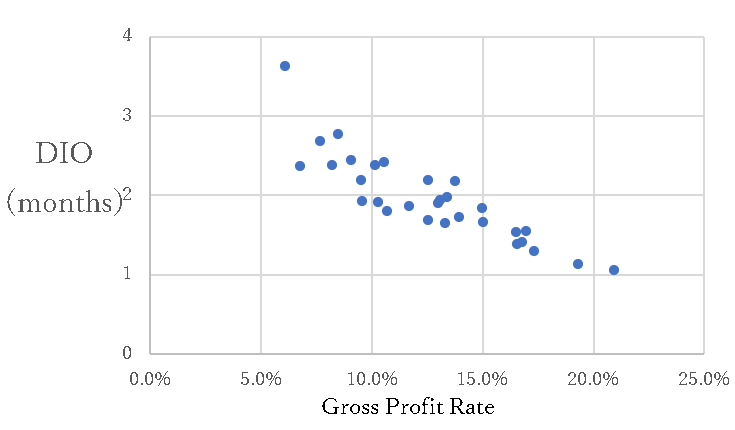
Carvana’s Quarterly Gross Profit Rate vs. DIO
In plain English:
The faster inventory moved, the more money Carvana made.
The slower inventory moved, the more profits disappeared.
This wasn’t a coincidence.
Inventory reduction became one of the most important drivers of the company’s recovery.
How Carvana Reduced Inventory So Aggressively
The most important strategic shift was moving from a growth-first mindset to a survival-first mindset.
Previously, Carvana’s goal was to maximize sales volume. One way to maximize sales is to offer the widest possible selection.
With more inventory, customers are more likely to find exactly what they want, reducing lost sales opportunities.
The downside is that some inventory inevitably becomes slow-moving.
A vehicle may sit for months or even years before finding a buyer. Eventually, heavy discounts become necessary.
Those discounts destroy margins and worsen cash flow. w. Worse yet, your capital becomes tied up in slow-moving inventory for years.
To solve this problem, Carvana narrowed its selection.
Also, the company leveraged machine learning models to predict which vehicles would sell fastest in each local market.
Instead of stocking everything, they stocked the right things. This allowed inventory levels to fall without causing a proportional decline in sales.
The result was faster turnover, higher margins, and stronger cash generation.
What Small Business Owners Can Learn
The lesson is much simpler. A cash flow problem is often an inventory problem.
Before looking for loans, investors, or new customers, look at where your cash is currently trapped.
Ask yourself:
- Which products haven’t sold in months?
- Which services consume time but generate little profit?
- Which inventory categories require constant discounting?
- Where is cash sitting idle?
The answers are often surprising.
5 Practical Ways to Improve Cash Flow
1. Identify Slow-Moving Inventory
List all products and rank them by sales velocity.
You may discover that a small number of products generate most of your revenue.
2. Liquidate Dead Stock
Holding old inventory rarely makes it more valuable.
A discount today is often cheaper than another six months of storage and carrying costs.
3. Focus on Fast Sellers
A smaller inventory of high-demand products can generate more cash than a massive inventory with slow turnover.
4. Track Inventory Turnover Monthly
What gets measured gets improved.
Monitor how long products remain unsold and set targets for improvement.
5. Optimize for Cash Flow, Not Revenue
Revenue looks impressive.
Cash pays the bills.
Always ask whether a decision improves cash flow, not just sales.
The Real Goal Isn’t More Sales
When businesses face a cash flow problem, the instinct is usually to chase more customers.
Carvana’s turnaround shows a different path. The fastest way to improve cash flow wasn’t selling more cars. It was freeing the cash already trapped inside the business.
For many small businesses, the biggest cash flow opportunity isn’t outside the company.
It’s sitting in the warehouse. On the shelf. Or in products that aren’t moving.
Before chasing growth, make sure your cash can keep up.