The One Thing Skyrocket Growth to “Septuple”: Finally VCs Chase You

In the world of business growth, timing is everything. The earlier you invest in your business, the greater your potential returns – thanks to the power of compounding. Business growth works exactly like compound interest. Interest makes your capital bigger, and bigger capital brings in more interest. When you invest more in your business, you get more customers and cash flow. Then you can reinvest that increased cash to generate even more cash flow. This cycle is what we call growth.
But what if you could accelerate this growth cycle by investing earlier?
The secret lies in strategic leverage. While many entrepreneurs start with just their savings – often a very small amount, the most successful ones understand how to use debt as a powerful tool. Today, I’ll reveal how leveraging debt strategically can make your growth much faster.
This isn’t about taking on debt because you are short of cash – it’s about investing it for hyper growth. When used correctly, debt will speed up your business growth so dramatically that venture capitalists won’t just notice you – they’ll chase you. In the VC world, nothing is more attractive than a business that’s already showing explosive growth.
I have to say if you are not using debt, your growth speed is like a snail. I’ll explain why.
How Debt Multiplies Your Growth Power
When you use debt, you can increase your cash to invest. If you have $10,000 and you borrow $10,000, the amount becomes twice. So the growth becomes twice, right? Actually, it’s much better than that.
Let me show you with a simple example:
Case 1: You spend $10,000 on sales and marketing to get 100 subscribers. Your monthly revenue is $1,000.
Case 2: You spend $20,000 (your $10,000 plus $10,000 borrowed) and get 200 subscribers. Your monthly revenue is $2,000.
In both cases, your fixed monthly cost is $500, and your variable cost is 40% of sales.
What are fixed and variable costs?
- Fixed costs don’t change with sales volume (like office rent)
- Variable costs increase with sales (like ingredients for each product sold): for example, if you sell rice bowls for $10 each and the rice costs $3, then when you sell two bowls, your sales double to $20 and your rice cost doubles to $6.
See the Magic in the Numbers
Look at the graph below. The blue part shows costs, and the gray part shows what you can reinvest for growth:
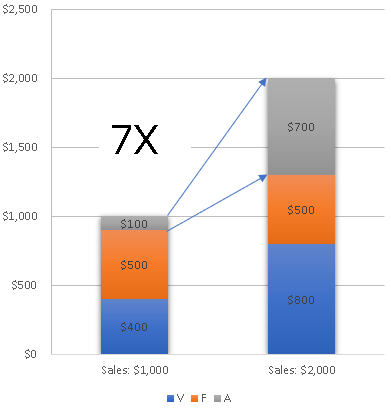
Case 1: Revenue $1,000 – Fixed costs $500 – Variable costs $400 = $100 available to reinvest
Case 2: Revenue $2,000 – Fixed costs $500 – Variable costs $800 = $700 available to reinvest
Your seed money only doubled, but your ability to reinvest and grow increased by 7 times (“Septuple”)!
Why This Happens: Economies of Scale
This happens because of economies of scale. No matter how much your sales increase, fixed costs stay the same, so the fixed cost per sale drops – in this case from $5 ($500/100) per sale to $2.50 ($500/200) per sale. This cost drop per sale gives you more profit and more cash to spend on growth.
The Effect Is Even Bigger with High Fixed Costs
The effect gets even stronger when your business has high fixed costs.
For example, if your fixed cost is $800 and variable cost is only 10% of sales:
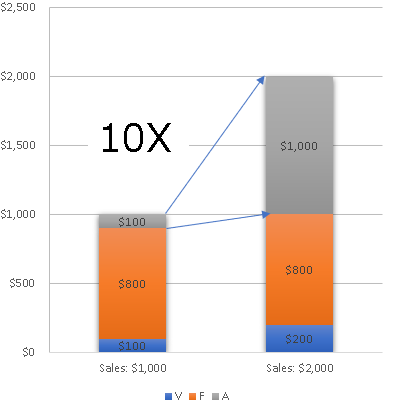
Case 1: Revenue $1,000 – Fixed costs $800 – Variable costs $100 = $100 to reinvest
Case 2: Revenue $2,000 – Fixed costs $800 – Variable costs $200 = $1,000 to reinvest
That’s 10 times more money for growth! Why such a dramatic difference? It’s all about how economies of scale work their magic when fixed costs dominate your business model.
As sales double from 100 to 200, your fixed cost per sale drops significantly – from $8 all the way down to $4. This means each sale now contributes $4 more to the bottom line. Do the math: with 200 sales at $5 profit each, you’re looking at $1,000 to reinvest in growth. Compare that to the original scenario: 100 sales at just $1 profit each gives you a mere $100 to work with. The difference is staggering.
In some cases, economies of scale don’t work. Read this article to learn when that happens.
Conclusion
Strategic debt isn’t just another funding option—it’s a growth multiplier. By leveraging debt intelligently, you can activate powerful economies of scale that transform your reinvestment to exponential.