Being Frugal Isn’t Enough… How to Stop Cash Bleeding

In the aftermath of the dot-com bubble burst in 2000, Salesforce found itself in a precarious position. The once-booming tech industry was now a wasteland of failed startups and skeptical investors. Venture capitalists, burned by the collapse, were no longer willing to pour money into dot-com companies. Even if a company can get VC, the valuations were so low that accepting investment meant significant share dilution—something Salesforce’s founder, Marc Benioff, was determined to avoid.
Salesforce, like many of its peers, tried to weather the storm through frugality. However, operational costs continued to eat away at their cash reserves. The company was bleeding money at an alarming rate of $1 million per month, with severely negative cash flow. While many fellow dot-com companies succumbed to cash crunches, Salesforce emerged as one of the few survivors—but not without a radical change in strategy.
To understand Salesforce’s predicament, it’s crucial to grasp the nature of their business. Salesforce is a SaaS (Software as a Service) company. SaaS is a software distribution model where a provider hosts applications and makes them available to customers over the internet. Salesforce specifically offers a cloud-based customer relationship management (CRM) platform, providing a shared information system for sales teams—a process known as sales automation.
The challenge lay in Salesforce’s business model. Customers paid monthly subscriptions, but Salesforce paid its sales representatives 12-month commissions upfront. This mismatch created a cash flow nightmare. Unlike traditional software companies that sold expensive licenses outright, Salesforce’s subscription model meant a constant trickle of income rather than large lump sums. This made it difficult to invest in expansion without significant capital, highlighting the importance of venture capital for many SaaS companies.
Benioff realized that the solution was exactly opposite to what they used to do: get paid faster and pay later. This insight led to a revolutionary change in Salesforce’s approach to pricing and payments.
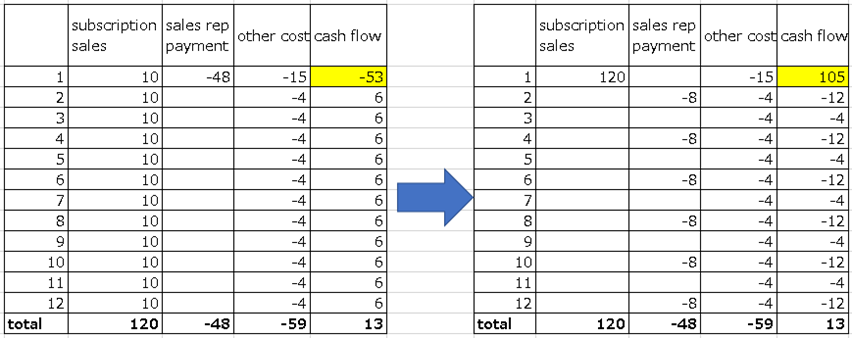
The company introduced an annual prepaid option, incentivizing customers to pay for a year in advance. To make this attractive without hurting profitability, Benioff devised an ingenious solution. Instead of offering discounts for annual prepayment, Salesforce kept the annual price the same but increased the monthly payment option. For example, if the monthly payment was previously $50, customers now had to choose between a $600 annual prepayment (the same total price) or a higher monthly rate of $65.
The quality of Salesforce’s software, combined with the lack of subscription-based alternatives in the market, meant that users didn’t abandon the service. Instead, many opted for the annual prepayment option.
Salesforce then aligned its sales compensation structure with this new model. Sales representatives were now incentivized to secure annual contracts, further encouraging prepayment subscriptions. Additionally, the company shifted to paying commissions every two months rather than upfront, significantly improving its cash position.
These changes dramatically enhanced Salesforce’s cash flow. The following table is an example of the situation. The company went from having to spend $53 to acquire each user and waiting months to recoup that investment, to a position where new sales immediately generated cash. This meant that increased sales no longer strained cash reserves but instead bolstered them.
Then they can invest their cash in sales and marketing, and as they generate more cash, they can reinvest it. This allows them to expand their business without capital. This strategy is known as bootstrapping.
By implementing these strategies, Salesforce not only avoided a financial crisis but also positioned itself for growth—all without the need for further equity dilution. This innovative approach to cash flow management became a cornerstone of Salesforce’s success, enabling it to emerge from the dot-com crash as a stronger, more resilient company.
References
Behind the Cloud: The Untold Story of How Salesforce.com Went from Idea to Billion-Dollar Company-and Revolutionized an Industry 1st Edition
by Marc Benioff (Author), Carlye Adler (Author)