Why Some Plummet, Some Thrive: The One Thing That Determines Your Business Growth

The Simple Truth About Business Growth
There is only one reason companies grow: reinvestment. Any company that fails to reinvest its acquired cash into future business opportunities will decline. It’s that simple.
Three Types of Companies
There are three types of companies: Type 1 companies don’t invest in the future at all, Type 2 companies invest but in the wrong things that won’t generate future cash flow, and Type 3 companies invest heavily in things that will bring strong future cash flow. Only Type 3 will thrive, while Types 1 and 2 will eventually fail. It’s like three farmers: one saves all his money under his mattress, another buys fancy tractors he doesn’t need, and the third carefully invests in good seeds and proper equipment.
Compound Growth
Growth is all about the compound effect. Capital grows through constant reinvestment of interest . Without reinvestment, there’s no increase in capital. The same principle applies to business. If you take profits from operations without reinvesting them, you’re getting simple interest instead of compound interest. How much and how early you reinvest your cash, along with the ROI (return on investment) of those investments, determines your business growth.
This is why cash flow is crucial for growth – it determines how much you can reinvest in your business and when you can do it (earlier is better). Just like a snowball rolling downhill, the earlier you start and the more snow you add, the bigger it becomes.
Reinvestment can take many forms – from marketing expenses and hiring top talent to purchasing efficient equipment or acquiring businesses, but the one that brings in the most future cash flow wins.
Japan vs USA
Let me give you an example that even applies to countries. Japan has been stagnant since 1993 (known as the lost 30 years). You can see this in the GDP data by country. These economic patterns show up clearly in national statistics.
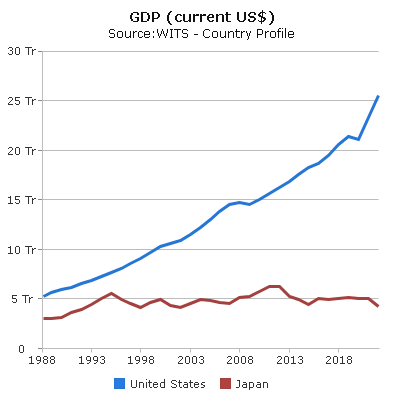
Japan’s Cautious (Seriously, Somebody Take a Risk!) Approach
This stagnation exists because Japanese people tend to put their income into savings rather than investments. About 55% of household assets go to savings, while only 14% go to stocks and bonds. These deposits barely grow because interest rates are very low in Japan. This creates a cycle where money sits idle instead of growing.
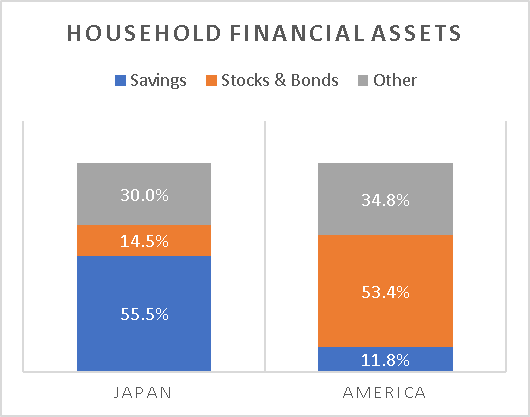
(from the OECD ‘Household Financial Assets’ 2019 report)
The banks must then lend out these deposits, but people are reluctant to start ventures with borrowed money because it’s too risky. If you personally guarantee a business loan and the business goes bankrupt, it can ruin your life. You end up with huge debt, a damaged reputation, and little chance to start again. This makes it very difficult to reinvest money in Japan as a country, making Japan a Type 1 country. This fear of failure creates a barrier to innovation and growth.
America’s Investment Culture
In contrast, Americans invest directly in ventures. Looking at the financial breakdown of household assets, 53% goes to stocks and bonds! This allows ventures to try new things because failure is less risky with invested money – they don’t have to pay back the capital if they fail. This high volume of venture investment drives innovation. While many ventures fail, having numerous attempts means some will succeed. There are plenty of questionable ventures, but the sheer amount of reinvestment puts America somewhere between Type 2 and 3 but closer to Type 2 (no offense, America – you’re still doing much better than Japan). The country has benefited from the compound effect of reinvestment and became prosperous even before recent attempts to “make it great again.” This culture of investment creates more opportunities for innovation and growth.
Your Business Strategy
Your company can be Type 3. Focus on being frugal and reinvesting all your operational cash flow into promising business opportunities that are likely to generate future cash flow. Calculate future cash flows carefully, avoid questionable business ventures, and take informed risks. Success comes from making smart choices about where to reinvest your profits, just like planting the right seeds in fertile soil.