4 SaaS Price Hike Mistakes: When You Lose Old Users and Can’t Win New Ones

A price hike can be the fastest growth lever in SaaS.
If you do it right, you get cash immediately. That cash lets you reinvest faster, acquire more customers, and accelerate growth. In some cases, even a tiny price increase can completely change your business.
For example, imagine your price is $100 and your cost per sale is $95. Your profit is only $5.
Now raise the price by just 5%. The new price is $105, but your cost stays $95.
Your profit jumps from $5 to $10. That’s 2× profit from a very small change.
This is why price hikes are so attractive.
But they’re also scary—and for good reason. A badly timed or poorly designed price hike can destroy growth, spike churn, or even bankrupt the company. Founders are right to be cautious.
The real question isn’t “Are price hikes dangerous?”
It’s “Which risks apply to my situation, and how big are they?”
Let’s walk through the four main risks, then look at when those risks become especially dangerous.
4 Price Hike Risks That Can Ruin Your Business
1. Churn Increases
This is the risk everyone worries about first.
When you raise prices, some customers will churn. That’s unavoidable. You can estimate how bad it might be with pricing tests, but zero churn is not realistic.
The real danger is who churns.
The Big Client Problem
If a single customer represents a large share of your revenue, a price hike becomes extremely risky.
Imagine one customer accounts for 30% of your revenue. If they churn, you instantly lose 30% of cash flow. You didn’t plan for that. You still have bills, salaries, and infrastructure costs. In the worst case, you can’t survive the shock.
Even worse, large clients often gain pricing power over you. If losing them would kill the business, you can’t negotiate freely anymore. You end up accepting their demands because you have no choice.
That’s why heavy reliance on a few big customers is dangerous.
If you’re in this situation, you should:
- Negotiate with those clients before raising prices, or
- Keep their pricing unchanged while increasing prices for others, or
- Most importantly, acquire more customers to dilute their influence.
General Churn Isn’t the Long-Term Problem
For smaller customers, churn usually spikes once after a price hike—and then stabilizes.
In many cases, churn actually drops below the old level later. Higher prices filter out bargain hunters and attract more serious users.
So long-term churn is often not the real issue.
The real issue is what happens before someone becomes a customer.
2. Conversion Rate Drops (and CAC Goes Up)
In a pricing test, if 1% of users say they would buy at the original price and 0.8% say they would buy at the new price, buying intent drops to 0.8×.
That sounds small, but it compounds quickly.
If you used to send 100 DMs to get one customer, now you need 125.
That alone increases your CAC by 1.25×.
It gets worse if the higher price forces you to change your sales motion.
For example:
- Before: marketing-only sales
- After: marketing + sales calls
Sales involvement dramatically increases CAC.
So even if revenue per customer goes up, growth can slow down if CAC rises too much.
This is why pricing decisions must be made financially, not based on gut feeling.
The key is finding the price that maximizes compound growth, not just revenue per customer.
A practical way to evaluate this is the first-month cash inflow / CAC ratio. This tells you how quickly you can reinvest.
SaaS growth is a compounding machine:
- The faster you recover CAC,
- The faster you reinvest,
- The faster the business grows.
Annual plans help here. If you collect 90% of the CAC in month one, you can immediately reinvest most of the original amount into acquiring more users.
A price hike that increases revenue but slows reinvestment can actually reduce growth. That’s why you must estimate this effect before touching pricing.
3. Annual Plan Subscription Rate Drops
Higher prices often reduce annual plan adoption.
At lower price points, paying annually is easy. At higher price points, it becomes a real financial decision.
For example, raising the annual plan from $10k to $20k can make upfront payment too hard for some customers.
This matters because annual plans are your growth fuel. They create large upfront cash inflows that let you scale faster.
If a price hike pushes users from annual to monthly plans, growth slows—even if MRR looks higher on paper.
4. Expansion Rate Drops
Expansion revenue offsets churn and is a core SaaS growth driver.
But if your price gets too high, users stop expanding usage:
- They limit seats
- They avoid upgrades
- They cap usage
Even happy customers can stop expanding if incremental usage feels too expensive.
When These Risks Become Especially Dangerous
Not all SaaS companies face the same level of risk. These situations make price hikes much more dangerous.
1. Your Value-to-Price Ratio Is Low

Price should be anchored to value—but how much value is “enough”?
A useful rule of thumb:
If users get more than 10× the value of what they pay, a price hike is safe.
Example:
If your product saves 50 employee hours per month, and:
- Average work hours: 170/month
- Average salary: $6,000/month
Then 50 hours saved ≈ $1,764/month in value.
Charging $176 or less per seat is an excellent deal. You have a huge buffer. Price hike here up to $176 is low-risk.
The bigger this buffer, the safer price increases become.
Some companies ignore this rule. Google Ads often charges close to the value it creates. In some cases, the value/price ratio is effectively 1× or even negative.
They can do this because they dominate the market.
Unless you have similar dominance, you usually can’t.
Perceived Value Matters More Than True Value
Pricing depends on perceived value. Objective value by itself isn’t enough to justify a higher price.
If you fail to communicate value, customers perceive less value and are willing to pay less.
You can increase the perceived value by marketing.
Perceived value increases when you can communicate the product clearly solves an important problem.
That’s why a unique selling proposition (USP) matters.
A USP explains what your product does better than others.
But you don’t define a USP in your head.
You discover it by talking to users again and again.
Those conversations show you:
- which problems actually matter
- where your product helps
- and what competitors are missing
Focusing on a niche makes this easier.
Niche products can solve very specific problems, and specific solutions usually feel more valuable.
The goal is not “high value” in general.
The goal is value competitors don’t provide.
That difference is what makes pricing safer.
And that leads to the next point.
2. Your Competitors Deliver More Value Than You
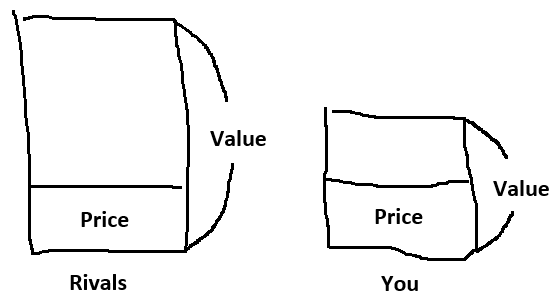
If your perceived value is higher than competitors’ and your price is lower, you are underpricing. In that case, raising prices aggressively makes sense.
But when the opposite is true — competitors deliver more value than you do — a price hike is dangerous.
In that case, lowering price may be better than raising it—especially if users can switch easily.
Which leads to the next risk.
3. Switching Cost Is Low
Low switching costs make price hikes extremely risky.
You’re in danger if:
- Your product is similar to competitors ‘
- User data is minimal or easy to export
- Setup and learning are trivial
- It’s a B2C product
- Integrations are shallow
- The product isn’t embedded in core workflows
When your rivals offer a better product at a lower price, they just leave.
4. Your Price Is Already High
Even when your product delivers much higher value, price level still matters.
At high prices, many users simply cannot pay the annual bill upfront. When that happens, they switch to monthly plans.
You must consider your users’ financial reality and whether they can afford the increased annual bill.
This becomes even more important during recessions, when cash constraints tighten.
When users move from annual to monthly plans, it creates a real growth problem.
Annual plans generate upfront cash. That cash is what funds faster reinvestment and compound growth. Monthly plans do not.
So if a price hike pushes users from annual to monthly, the hike backfires:
- Revenue per customer may increase
- But reinvestment speed slows
- Growth rate drops
That’s why annual payment rate is one of the most important SaaS growth metrics.
Even if your annual payment rate drops, there are still many ways to increase it using pricing hacks.
5. Your Product Doesn’t Generate Cash as Usage Expands
Expansion works best when usage creates money for users.
Value alone isn’t enough.
Think of a chef who cooks god-level food. The food may have infinite value to a gourmet, but the customer still has a limited budget.
At some point, they stop spending—not because the food isn’t valuable, but simply because they don’t have money to pay more.
But if a product helps users generate revenue or save money, they can reinvest that cash into using more of it.
Expansion fails when your pricing doesn’t match what users actually value. If using more of the product doesn’t clearly feel like getting more value, users won’t expand.
Final Thought
Price hikes are powerful—but only when the underlying economics support them.
Before raising prices, you must understand:
- Who might churn
- How conversion and CAC will change
- Whether annual cash inflow will drop
- Whether expansion will slow
Pricing isn’t about courage or fear.
It’s about cause and effect.
Get that right, and price hikes become a growth engine—not a gamble.