Pricing Secrets: How to Make Yearly Plans Irresistible

The Growth Power of Annual Subscriptions
For subscription businesses, securing yearly payments is a fundamental strategy in their playbook. The impact can be tremendous – companies where 50% of users choose yearly payment options often experience growth that’s 10 times greater than companies offering only monthly subscription options. This dramatic difference occurs because subscription revenue grows like a snowball effect.
Yearly payments enable you to collect CAC (per customer acquisition cost) much faster, creating a financial advantage. When you recover your acquisition costs earlier, you can reinvest that cash back into your business sooner. Growth is a compound effect. Yearly payment makes the reinvestment cycle faster.
For example, I compared the growth of yearly vs. monthly payments. The CAC is $1,500, the initial cash is $3,000, and the monthly churn rate is 3%:
- Option A: Yearly fee is $1,000
- Option B: Monthly fee is $100 ($1,200 per year)
I ran a simulator where you reinvest in customer acquisition immediately after receiving cash. You can reinvest much faster if your customers choose yearly payment.
With option A, you invest $3,000 and get $2,000 ($1,000 × 2) immediately as yearly fees. Then you can reinvest it again and get another $1,000 income immediately.
But with option B, you invest $3,000, then receive $200 each month, so it takes another 7 months to accumulate $1,600, and you can finally reinvest the cash. This delays reinvestment.
As a result, option A will have 119 customers at month 72, while option B will have only 15 customers at month 72.
Even if the yearly fee is lower at $1,000, yearly payment, a.k.a. the frequent reinvestment enabler, is much more advantageous in many cases. Plus, yearly payment customers stay longer than monthly customers for reasons I’ll explain next.
That is why acquiring more yearly payment customers is very important for your SaaS growth.
The Hidden Benefits of Annual Plans
By implementing strategic pricing approaches, you can effectively guide customers toward choosing yearly plans over monthly options. And yearly plans naturally lower your users’ quitting rate (churn rate). This happens for several reasons:
- When customers make larger initial payments, their commitment level automatically increases. Higher commitment typically translates to lower churn rates
- Annual subscribers only have one opportunity per year to cancel, whereas monthly subscribers have twelve. Fewer quitting opportunities naturally results in higher retention rates
The Psychology of Decoy Pricing
Here’s the secret: Use decoy pricing to your advantage. People don’t inherently know whether a price is high or low until they can compare options. For example, $100 for water seems extremely expensive, but if you’re in a desert and other water sellers are charging $1,000, that $100 price tag suddenly becomes attractive.
Decoy pricing involves intentionally adding a price tier that makes your target option more attractive by comparison. This leverages the natural human tendency to make decisions based on relative value rather than absolute value.
Think about Dating
Think of it like this: if you go to a bar to pick up someone, bringing a friend who is similar to you but slightly less attractive is a great advantage to you. This companion serves as a reference point, allowing others to easily compare and better understand your value in contrast.
The key is choosing a person similar to you as a wing person. If you bring someone whose type is completely different—for example, you’re a professor and you bring a gangsta rapper as your wing person—the comparison becomes difficult, and people can’t easily see your benefits.
For effective comparison, you want to present features that are mostly similar: Feature 1 (like income level) and Feature 2 (like height) are the same, but Feature 3 is where your advantage lies (such as being better at karaoke than your friend or being able to drink a lot of alcohol without dying).
In a carefully constructed comparison, you naturally look more appealing.
Decoy Pricing in Action
Decoy pricing is essentially about adding that “dorky friend” to make your preferred option shine. Let’s explore three effective patterns of decoy pricing that can dramatically influence customer decision-making.
Three Patterns of Decoy Pricing
Here’s a simple breakdown of how decoy options can be structured:
Pattern 1: Fewer Features, Same Price
Pattern 2: Same Features, Higher Price
Pattern 3: Higher Price and Fewer Features
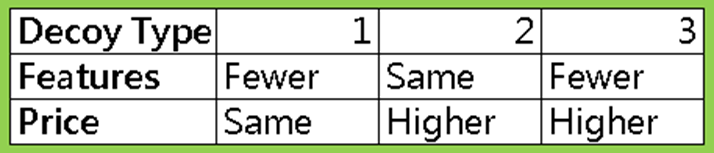
Pattern 1: Fewer Features, Same Price
A company can show apparent value by adding a strategically inferior option. The Economist- a news and current‑affairs magazine with an online version, demonstrated this perfectly:
Original options:
- Web-only: $59
- Print & Web: $125
Result: Only 32% chose the expensive option.
After adding a decoy:
- Web-only: $59
- Print-only (Decoy): $125
- Print & Web: $125
Result: 84% chose Print & Web.
The decoy shifted the comparison from price difference (web only $59 VS print & web $125) to value comparison (print-only VS the same price, more value, print & web).
When applied to annual pricing, the display looks like this:

Target and decoy are the same price. Both are cheaper than monthly. But target has more features.
Pattern 2: Same Features, Higher Price

Add a more expensive option that’s identical to your product to make your target option look like a bargain.
Example:
- Option 1: Monthly plan, few features – $12/month
- Option 2 (Decoy): $12/month (billed annually), more features than Option 1
- Option 3 (Target): “Golden Plan” yearly payment – $10/month (billed annually), same features as Option 2
The decoy (Option 2) has the same features as Option 3 but costs more. So, naturally, no one would choose it. Option 3 appears to be an outstanding deal because it’s cheaper than Option 2 yet offers identical benefits, and it provides more features than Option 1.
Pattern 3: Higher Price and Fewer Features

This is the most powerful pattern, where the decoy is both more expensive and offers fewer features than your target option.
Example:
- Option 1: Monthly plan, fewer features – $12/month
- Option 2 (Decoy): Yearly plan, fewer features – $10/month (billed annually)
- Option 3 (Target): “Special Limited Offer” yearly plan – $9/month (billed annually) with many additional features
Option 3 becomes irresistible because it’s cheaper than even Option 2 and offers more features. Option 2 already seems better than Option 1 because it’s cheaper annually, and Option 3 is even better than Option 2 because it’s both cheaper and feature-rich, making it appear like the ultimate choice.
Enhancing Decoy Effectiveness
To make your decoy pricing even more effective, add elements of exclusivity: these provide a natural explanation for why Option 3 is so much better than the decoy Option.
1. Limited-Time Offers
Present your target option as a limited-time sale. You can effectively run “special pricing” year-round through seasonal promotions (spring sales, summer sales, autumn sales, winter sales). Even when customers understand they could wait for the next sale, they’ll often rush to purchase at the limited price due to:
- A sense of urgency
- Fear of missing out
- Deadline pressure
- Perceived scarcity
The psychological impact of these factors makes customers view the promotional price as an even better value than if it were always available.
2. Membership Exclusivity
Make your best pricing option (Option 3) available only to “club members.” The key is to ensure that becoming a member is very easy. Like joining a Facebook group. You can set up your community very easily now. This approach offers multiple benefits:
- It fosters loyalty to your product company
- Members tend to teach and support each other, reducing churn
Implementation Tips
Test different decoy settings to determine which works best for your specific audience and product. Don’t rush this process—testing will yield the most effective results.
If you use decoy pricing for all tiers, you’ll end up showing too many price options at once, which can confuse buyers. To avoid this, first have customers select their tier (Small, Middle, Enterprise), then show only the 3 pricing options (monthly, decoy, and yearly) for that specific tier. This makes it easier to guide them to your preferred option.