Why More Sales Create Cash Flow Problems (and One Simple Fix)

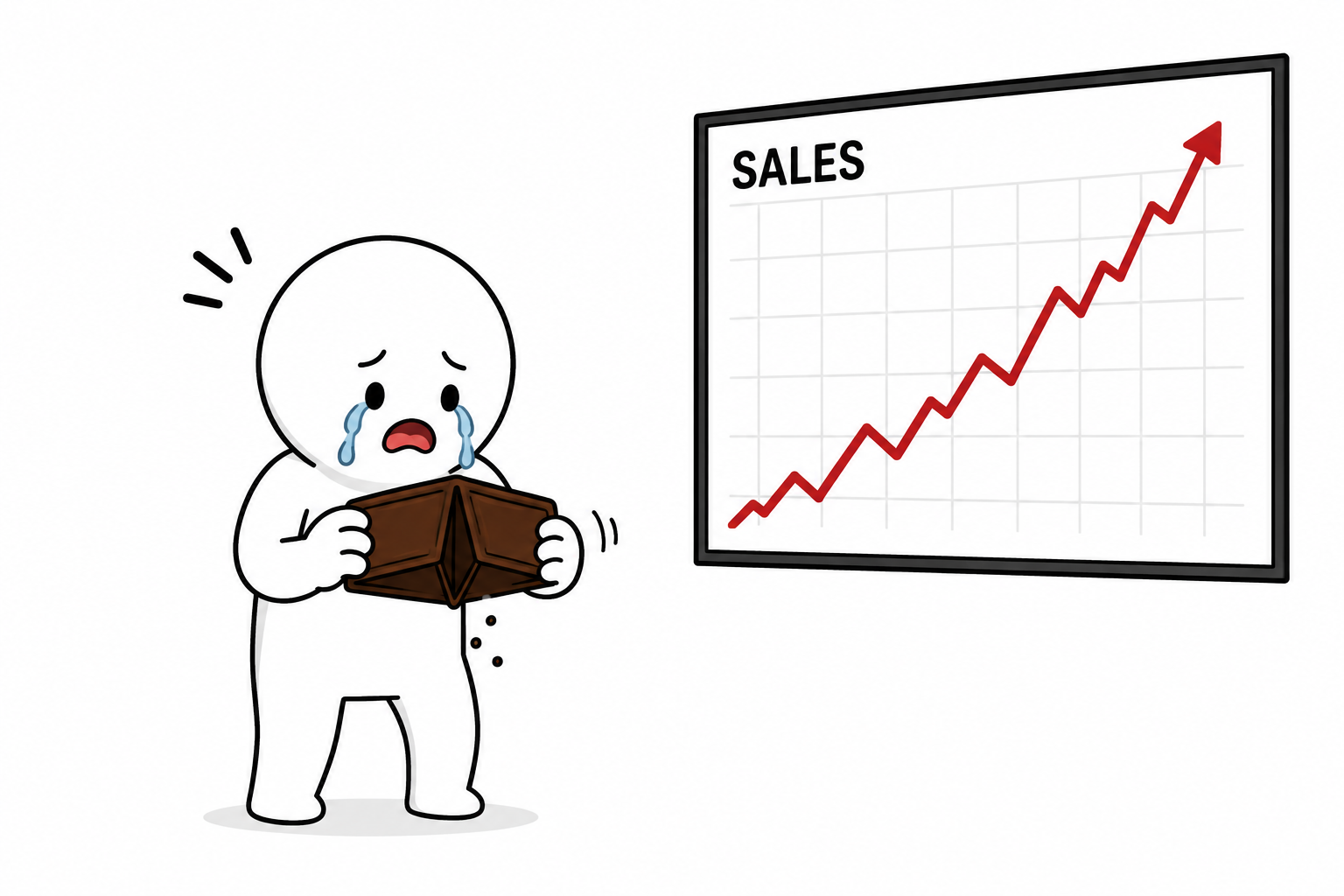
The fix is simple: make the time between paying out and getting paid as short as possible. The shorter this period, the less cash you need to keep your business running.
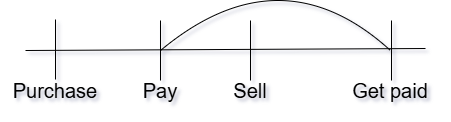
In business, you almost always have to spend money before you earn it — buying inventory, paying for ads, covering salaries, processing materials, and more. To grow sales, you invest heavily upfront, and it takes time before that money comes back to you. More sales means more cash going out first.
Here’s a concrete example:
- Net profit margin: 3%
- Inventory held: $100
- Annual sales: $200
To double sales to $400, you’d need to double your inventory. At that profit rate, you’re only accumulating $6 per year — meaning it would take 17 years just to save enough to fund that expansion. And remember, inventory is just one piece. There are many things you must pay for long before you make a sale and actually collect the cash.
The Four Business Stages Before You Earn Cash
Every business goes through four stages before cash actually lands in your pocket: 1. Purchase 2. Pay 3. Sell 4. Get Paid.
The critical window is the Pay → Get Paid period — this is when your spending piles up without any income coming in.
For example, if this period is 4 months and you sell $100 worth of inventory per month, costs pile up to $400 before a single dollar of sales cash comes back to you . Shortening this window is the key to solving cash shortages. This period is formally known as the Cash Conversion Cycle (CCC).
Four Ways to Shorten the CCC
1. Delay purchasing (→) as long as possible
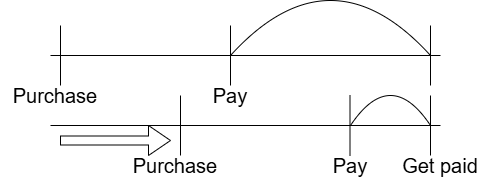
Instead of buying in large batches, purchase more frequently in smaller amounts. For example, rather than buying $100 of inventory at the start of the month, buy $25 every week. Compare these two cash flow timelines (assuming you receive $30 each time you sell):
- Batch purchasing: (−100, +30, +30, +30, +30) — requires $100 upfront
- Frequent purchasing: (−25, +30, −25, +30, −25, +30, −25, +30) — much less cash required.
The batch approach demands a large sum upfront, which makes it very difficult to scale.
2. Delay payment (→) as long as possible
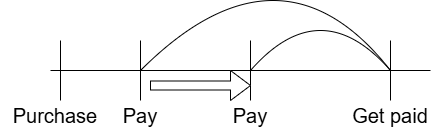
Negotiate longer payment terms with your vendors — even Net 15 can make a meaningful difference. To get vendors to agree, offer them something valuable in return:
- Volume commitment — “We expect to order $X consistently every month”
- Exclusivity — “You’ll be our primary supplier for this category”
- Long-term contract — predictable revenue makes vendors more flexible
- Auto-pay setup — “We’ll pay automatically on Day 45, no chasing” — vendors love the reliability
When negotiating, start by asking for longer terms than you actually need — for example, request Net 60 even if your real goal is Net 30. Then “compromise” down to Net 30. This gives you room to land where you want.
3. Sell faster (←)
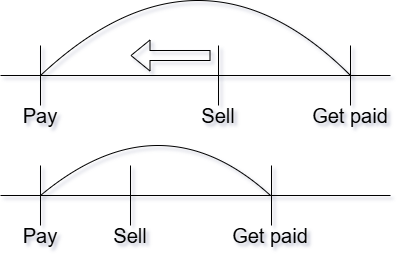
The quicker you sell, the sooner cash starts coming in:
- Stock only fast-moving items and cut slow sellers
- Offer annual payment bundles (sell 12 months upfront)
I’ve written a full deep-dive on inventory reduction — link below.
→How to reduce your inventory using 80/20 rule
→8 lessons from the World’s Leanest Retailer
4. Shorten the Sell to Get Paid period (←)
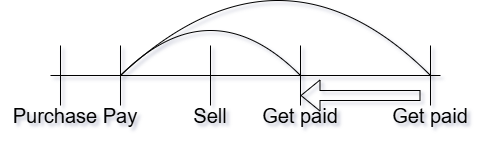
Reduce the time between making a sale and actually receiving the money:
- Tighten your receivables terms — for example, move from Net 60 to Net 30
- Offer an incentive for immediate payment, such as a 3% discount for paying on the spot
→See my full article on collecting receivables faster.
Let’s Look at a Realistic Scenario Simulation
To see how these tactics actually play out, let’s walk through a concrete example. Here’s the setup:
- Receivables: Net 30
- Purchasing: Pay immediately (no negotiation power yet)
- Products: 10 items, long-tailed, all bought at $60 and sold at $100
1. No tactics — baseline
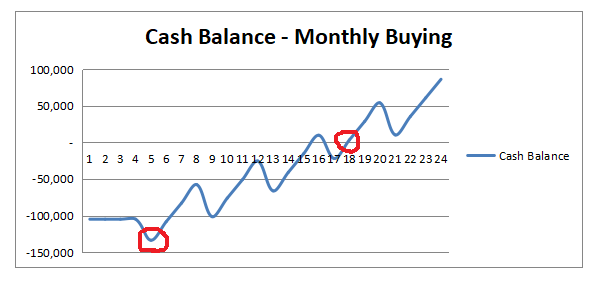
The lowest cash balance hits −$133k at week 5. This is the cash you must invest upfront into the cycle — purchasing inventory, waiting to sell it, then waiting to get paid — before any money comes back to you. It takes 18 weeks to recover that investment, meaning your accumulated cash inflows finally equal your accumulated cash outflows.
Doubling the business means you’d need to put in another $133k first. That’s a steep price just to scale.
2. Purchase more frequently
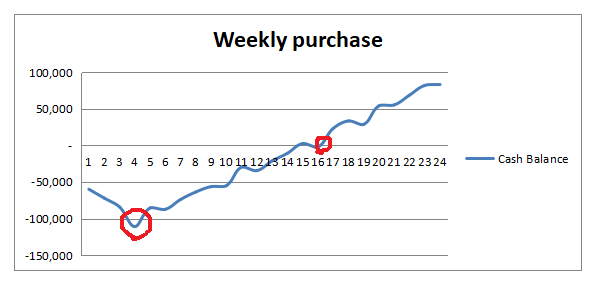
Instead of ordering a month’s worth of inventory at once, order every week. This keeps your purchase timing as close as possible to when you actually sell — delaying cash out for as long as possible.
The result is modest but real: the lowest cash balance improves to −$111k, and investment is recovered by week 17. Buying more frequently alone doesn’t transform the picture, but it’s a foundation for what comes next.
3. Tactic 2 + negotiate Net 15 with vendors
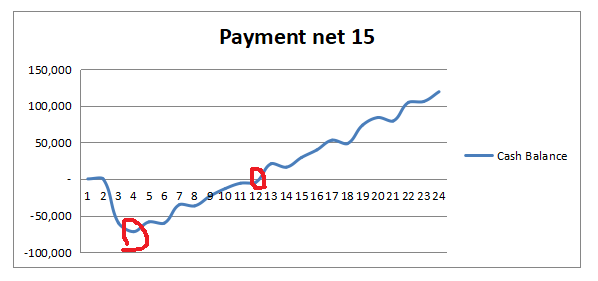
Now add vendor payment terms to the mix. Even moving from paying immediately to Net 15 makes a big difference.
Why? On Net 30 receivables, your first month brings in zero cash — but costs keep piling up regardless. Getting even two extra weeks before you have to pay vendors buys crucial breathing room. The lowest cash balance improves to −$72k, recovered by week 13. A much more manageable position.
If you can secure Net 30 for your vendor payments, it’s even better. The lowest balance is −$34k, recovered by week 9.
4. Tactics 2 + 3 (Net 15) + cut slow-moving items
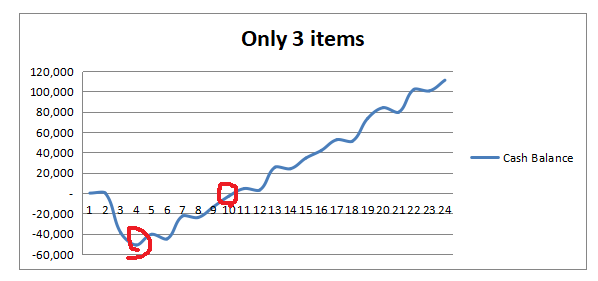
Cut items 4 through 10 and keep only the top 3. This is the 80/20 rule at work — your top sellers dominate the majority of your sales, so dropping the long-tail slow movers costs you very little in revenue while significantly reducing the inventory you need to hold at any given time.
Less inventory means less cash tied up in the cycle. The lowest balance improves to −$51k, recovered by week 11.
5. Tactics 2 + 3 + 4 + annual contracts
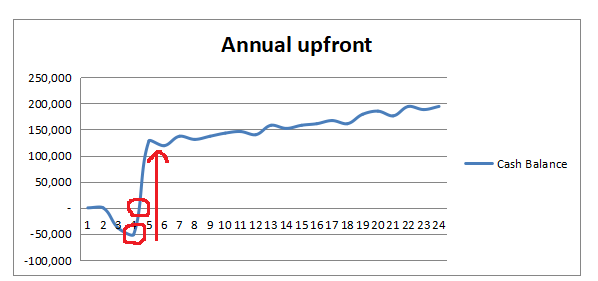
Now introduce annual contracts: customers pay for a full year upfront in exchange for a 20% discount. Assume 20% of your sales shift to this model.
Upfront payments are powerful because they completely flip the cycle — you get paid before you even purchase inventory. The lowest balance stays at −$51k, but investment is recovered in just 5 weeks, less than one third of the baseline.
See that sudden surge in the cash balance? It comes from the entire annual payment hitting at once — far bigger than weekly sales, even if 20% of your customers pay annually.
Push this further: if annual contract customers pay immediately rather than on Net 30, you get $172k immediately, and the lowest balance becomes +$118k (yes, positive — cash‑positive from the beginning to the end). At that level, expansion becomes dramatically easier and faster.
6. Tactics 2 + 3 + 4 + 5 + early payment discounts
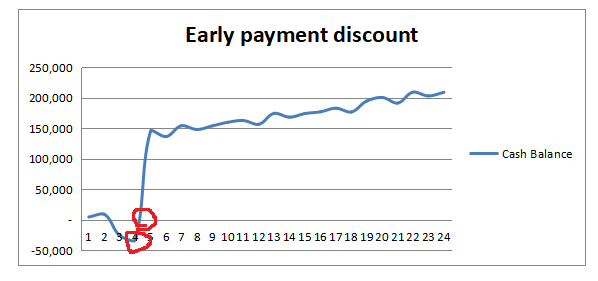
Finally, offer a 3% discount for customers who pay immediately instead of waiting for Net 30. Assume this converts 20% of your remaining customers into early payers.
This shortens the tail end of the cycle — the gap between selling and actually receiving cash. The lowest balance comes in at −$33k, and investment is fully recovered within 5 weeks.
The Difference It Makes
| Baseline | With All Tactics | |
|---|---|---|
| Lowest cash balance | −$133k | −$33k |
| Investment recovery | 18 weeks | 5 weeks |
Each tactic alone moves the needle a little. Stacked together, they transform the cash dynamics of your business — letting you grow faster with far less capital tied up in the cycle.
Your business is growing but your bank account keeps shrinking. A cash flow specialist CPA will fix that. First consultation is free.
Book Free 10-min Expert Session