Cash Tight? Kill the Pressure With This Cash Flow Forecast Template


This cash flow forecast template, created by an expert CPA, helps small business owners eliminate cash shortages, reduce stress, and grow faster.
Running a small business when cash is tight feels like trying to breathe underwater. The bills don’t stop, payroll doesn’t pause, and the anxiety follows you to bed every night.
I built this cash flow forecast template specifically for small business owners who are stuck in a cash-tight situation — people who want to stop the bleeding, avoid cash shortages, and still find a way to grow faster.
If you use this template correctly, it will eliminate your cash shortage problem. Not reduce it. Eliminate it. That means less pressure, less stress, and yes — you’ll actually sleep well again at night.
But before you open the template and start filling it in, you need to understand the two fundamental forces that control your cash flow. Skip this part and the template is just a spreadsheet. Understand it, and the template becomes a roadmap out of your cash crisis.
The 2 Elements That Decide Your Cash Flow
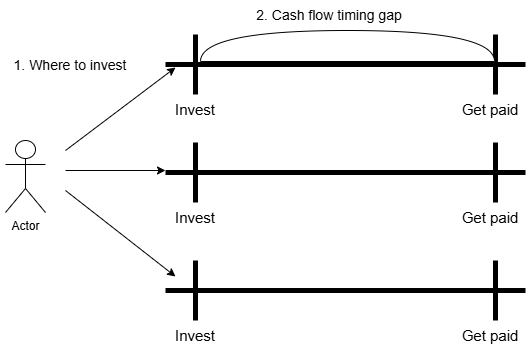
1. Your Investment Determines Your Future Cash Flow
Future revenue only exists because you invested in something beforehand.
That investment comes in several forms: customer acquisition costs (CAC), inventory, variable costs that rise as your sales volume grows, and capital investments like equipment or machinery that increase your production capacity.
The critical insight here is that where you invest determines how much cash flows back to you. Not all investments return the same. A dollar spent on the wrong marketing channel, bloated inventory, or a machine with low utilization is a dollar working against you.
Your job is to pick the investments that give you the highest return on investment (ROI) — the best possible return for every dollar you put in.
2. There Is Always a Timing Gap Between Investment and Getting Paid
You almost always have to invest first. Then you wait. Sometimes months. Sometimes years. You purchase inventory before you sell it. You run ads before customers buy. You deliver the product or service before the invoice is paid.
That gap between when cash goes out and when cash comes back in is where small businesses get crushed.
Here’s what makes this dangerous: even when your ROI is high — even when your business is genuinely profitable — poor cash timing can still take your business under.
Or at minimum, it makes it nearly impossible to expand, because you simply don’t have the cash on hand to fund the next round of growth.
This is why you must look at both ROI and cash timing together. You can’t optimize one without the other. The goal is to build a plan that maximizes total cash flow by improving both dimensions simultaneously.
How Cash Flow Is Actually Generated
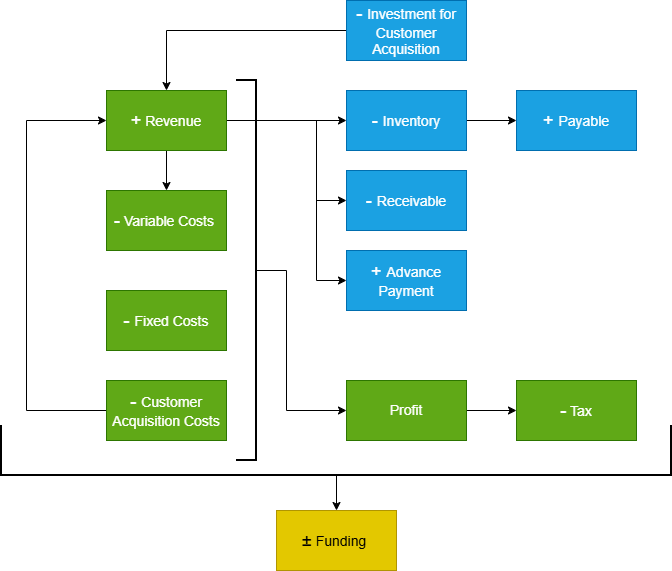
This diagram shows the precise mechanics of how cash moves through your business. Negative numbers represent cash flowing out. Positive numbers represent cash flowing in.
Here’s how the cycle works, step by step. You start by purchasing inventory or capital equipment. This increases your inventory balance and your accounts payable at the same time. Then you pay that bill — your payable decreases, and cash leaves your account.
You invest in CAC to acquire new customers or sell more to existing ones. When a sale happens, your inventory decreases and your accounts receivable increases, because you’ve delivered the product but haven’t been paid yet.
Then you wait — Net 30, Net 60, whatever your terms are. Finally, the payment arrives, your receivable is collected, and cash comes in.
Everything is connected. Every single step feeds into the next.
That’s why expanding a profitable business still feels impossible — you have to fund each link in the chain before the previous one has paid you back. No wonder cash feels tight even when the business is working.
In the template, all of these flows are calculated automatically. You input your numbers, and it maps out exactly where your cash is going and when it’s coming back.
4 Ways to Become Cash Rich
Once you understand the structure, you can act on it. There are four levers you can pull to dramatically improve your cash position — and the template lets you model each one before you make any changes in the real world.
Lower your CAC by improving conversion rates and focusing on higher-ROI channels.
Cut variable costs wherever possible without sacrificing quality.
Reduce your inventory levels by tightening your purchasing cycles and improving demand forecasting. I’ve written a full deep-dive on inventory reduction — link below.
The faster you collect receivables, the faster you can reinvest that cash into the next growth cycle. Even shaving 10 days off your average collection time can dramatically change your cash position.
Extending your payable payment terms — negotiating Net 60 or Net 90 with suppliers instead of Net 30 — gives you more time to collect revenue before cash goes out the door. This is exactly how Dell built one of the most cash-efficient businesses in history.
When customers pay annually upfront instead of monthly, you receive cash long before you’ve delivered the full value. This single shift can transform a cash-tight business into a cash-rich one almost overnight.
AAnnual upfront isn’t limited to subscription businesses. Even if you operate in a non‑subscription context, you can still structure an annual upfront commitment — commonly called an Annual Prepaid Supply Agreement.
For more detail, read this article’s ‘Strategy 5.’
To increase your annual upfront conversions, read this article on decoy pricing and annual subscription strategies — it walks through how to raise your win rate when negotiating annual plans.
The power of this cash flow forecast template is that it lets you model all four of these levers before you make any real-world changes. You can see exactly how much additional cash each tactic will generate for your specific business — so you can prioritize what to do first and build a clear action plan.
Get the Cash Flow Forecast Template
You now have the framework. You understand the two forces driving your cash flow, you can see how every transaction connects in the cycle, and you know the four tactics that will turn the tide.
Now it’s time to put your own numbers in.
Fill out the form below — get the template, fix your cash flow, sleep well tonight.